Volume 24 article 1349 pages: 509-517
Received: Feb 25, 2026 Accepted: Jun 23, 2026 Available Online: Aug 02, 2026 Published: Aug 17, 2026
DOI: 10.5937/jaes0-65173
CLASSIFICATION AND LABORATORY CHARACTERIZATION OF SELECTED PHASE CHANGE MATERIALS FOR LOW-TEMPERATURE THERMAL ENERGY STORAGE
Abstract
The aim of this paper is to investigate and compare the thermodynamic characteristics and the heating and cooling behaviour of three phase change materials under conditions representative of practical operating conditions in hot water storage systems. Experimental measurements of temperature profiles, melting and solidification times, together with calculations of the absorbed and released heat, are used to identify the material that provides the optimal balance between efficiency, reliability, and practical applicability.
Highlights
- Three phase change materials were evaluated under identical heating and cooling conditions.
- Thermographic analysis revealed distinct phase transition behavior for paraffin and salt hydrates.
- Sodium acetate trihydrate demonstrated the highest latent heat storage capacity.
- Significant supercooling was observed for sodium thiosulfate pentahydrate during cooling.
Keywords
Content
1 Introduction
The increasing share of renewable energy sources in the energy sector places ever higher demands on the efficient storage of thermal energy [1]. One of the main problems associated with the use of solar collectors, heat pump systems or low-temperature heat sources is the mismatch between the moments of production and the moments of consumption [2]. Therefore, there is a need for reliable heat storage systems that are able to accumulate energy during periods of low consumption and release it when it is most needed [3, 4].
For this reason, phase-change materials (PCMs) are a key technology for increasing the efficiency of storage systems. By using the latent heat during a phase transition – usually from a solid to a liquid state and vice versa – these materials can store significantly larger amounts of energy compared to conventional heat storage devices that rely only on sensible heat. It is the presence of a distinct melting/solidifying temperature interval that ensures a stable operating temperature, which is of particular importance in maintaining an optimal temperature regime in hot water storage systems [5].
PCMs have many advantages: high energy density, relatively small volume with large heat capacities, good temperature stability and the ability to undergo multiple cycles without significant changes in characteristics, especially with optimally selected materials. These properties make them a preferred element in innovative low-energy and renewable energy systems.
Currently, various groups of PCMs are used – organic, inorganic and eutectic mixtures – each with its own specific advantages and limitations, which are discussed in the article. Among them, particularly promising for applications in hot water storage systems are materials whose melting temperatures fall in the range of 40–60 °C – the area in which thermal energy is typically accumulated and used in domestic and public heating and hot water installations.
1.1 Analysis and classification of different types of phase change materials (PCMs)
PFMs can be classified into three main groups – organic, inorganic and eutectic mixtures [6]. Each group is characterized by specific physicochemical properties that determine its applicability in energy systems.
1.2 Organic PFMs
Organic materials are one of the most widely used phase-change materials, thanks to their chemical stability, non-corrosiveness and excellent cyclic stability during repeated melting and solidification [7]. They are safe to use and suitable for various applications, including in thermal energy storage systems.
- Paraffins (CnH₂n+2) are mixtures of linear alkanes and are the most used organic PFMs. They are characterized by relatively low thermal conductivity but excellent chemical inertness. Paraffins have a well-defined melting point, good capacity for repeated melting and solidification, and do not exhibit phase separation, making them reliable for long-term use [8].
- Fatty acids have slightly higher thermal conductivity than paraffins and demonstrate good thermodynamic stability. However, they are more expensive and require more specific processing conditions. Among the most used fatty acids are stearic, palmitic and oleic acids.
- Polyethylene glycols (PEG) are organic polymers whose properties depend on molecular weight. They allow for control of melting temperature and are characterized by good miscibility and stability over multiple cycles. However, polyethylene glycol is sensitive to moisture, which may require additional protection measures.
The advantages of organic PCM include chemical neutrality, safe operation, lack of supercooling, and high resistance to repeated cycles. Their main disadvantages are low thermal conductivity and the relatively high cost of some types, as well as flammability at high temperatures, especially for paraffins.
1.3 Inorganic PCMs
Inorganic PCMs, most often salt hydrates, are highly suitable for use in thermal energy storage systems due to their high latent heat, wide temperature range with almost constant temperature at the phase transition, and higher thermal conductivity compared to organic materials. This group includes salt hydrates such as sodium thiosulfate pentahydrate (Na₂S₂O₃·5H₂O) and sodium acetate trihydrate (NaCH₃COO·3H₂O).
These materials have high energy density, making them extremely effective for heat storage and applications requiring compact and powerful thermal buffers. However, inorganic PCMs have several limitations, such as supercooling and phase separation, and many salt hydrates can be corrosive toward common container materials, which necessitates appropriate containment strategies [9]. Recent studies on sodium acetate trihydrate show that supercooling does not always have to be treated solely as a drawback: it can be induced and controlled to enable delayed/triggered latent heat release for long-term thermal energy storage, typically activated by heterogeneous seeding (intentional crystallization triggering) [10]. This highlights why supercooling control is an important design parameter in salt-hydrate PCM systems rather than only a phenomenon to be eliminated. Phase separation is another problem – during repeated melting and solidification cycles, some of the water of crystallization in salt hydrates can separate or migrate from the crystal lattice. This is due to non-uniform melting and crystallization, differences in the crystallization rate of individual components, and mechanical stresses associated with volume changes during the phase transition. As a result, phase separation occurs, which reduces the heat storage capacity, changes the phase transition temperature, and reduces the cyclic stability of the material.
Also, many salt hydrates are corrosive to metal surfaces, which requires the use of special containers or their integration with corrosion-resistant materials. In practical PCM implementation, encapsulation, especially microencapsulation, is widely used to reduce leakage and improve handling and long-term stability. The emulsification and processing conditions strongly influence capsule morphology and, consequently, the thermal performance of the encapsulated PCM system [11]. Despite these limitations, salt hydrates remain preferred in engineering applications due to their low cost, high heat capacity, and recyclability. They are widely used in thermal storage systems, solar collectors, cooling systems, and other energy efficiency technologies where a large capacity for heat storage at a relatively constant temperature is required.
1.4 Eutectic mixtures
Eutectic PCMs are combinations of two or more components (organic, inorganic or mixed systems) selected in strictly defined proportions, at which the mixture melts and solidifies at a strictly defined temperature. At the eutectic point, the components melt and solidify simultaneously, which provides a sharp phase transition and stable thermal behavior.
One of the main advantages of eutectic mixtures is the ability to precisely adjust the phase transition temperature, since it can be adjusted by changing the composition. This makes them particularly suitable for applications where a match between the operating temperature of the system and the phase transition of the PCM is required. In addition, many eutectic systems demonstrate good thermal stability under repeated melting and solidification cycles and minimal supercooling.
The most common are eutectic mixtures composed of two organic components, for example combinations of fatty acids or alcohols, which offer good chemical resistance and are non-corrosive. On the other hand, inorganic (salt) eutectic mixtures, including those based on chlorides, nitrates or hydrated salts, can provide higher energy density and better thermal conductivity, but are often corrosive and require more complex processing.
Despite their advantages, the production of eutectic mixtures can be uneconomical, as high purity of the components and precise control over the composition are required. With certain eutectic systems, there is a risk of phase separation or thermal instability during prolonged operation, especially when the composition of the mixture is not optimally balanced. However, thanks to the possibility of optimizing the melting temperature, eutectic PCMs are widely used in electronics, heating and cooling systems, as well as in solar technologies, where high accuracy and reliability of the phase transition are required [12].
2 Materials and methods
2.1 Thermophysical and Operational Characteristics of the Selected PCMs
In this study, three types of phase change materials (PCMs) were analyzed: paraffin, sodium thiosulfate pentahydrate (Na₂S₂O₃·5H₂O), and sodium acetate trihydrate (NaCH₃COO·3H₂O). The key thermophysical properties of these PCMs, which are indicative of typical commercial products and may vary depending on purity and manufacturer, are summarized in Table 1.
Table 1. Thermodynamic characteristics of PCMs
|
Material |
Type |
Chemical formula |
Melting temperature Tₘ (°C) |
Latent heat λ (kJ/kg) |
Cp (kJ/kg·K) |
ρ (kg/m³) |
Advantages |
Disadvantages |
|
Paraffin |
Organic |
CnH₂n+2 |
~55–58 |
150–210 |
~2.1 |
770–900 |
Stable, safe, no overcooling, non-corrosive |
Low thermal conductivity, slower heat transfer |
|
Sodium thiosulfate pentahydrate |
Salt-hydrate |
Na₂S₂O₃·5H₂O |
~48 |
200–250 |
~1.8 |
1700–1800 |
High density and thermal conductivity, good heat transfer, low cost |
Supercooling, possible phase separation |
|
Sodium acetate trihydrate |
Salt-hydrate |
NaCH₃COO·3H₂O |
~58 |
260–290 |
~2.0 |
1450–1500 |
Very high thermal conductivity, suitable melting temperature, affordable |
Need for thickeners/nucleators for stability |
The selection of paraffin, sodium thiosulfate pentahydrate (Na₂S₂O₃·5H₂O) and sodium acetate trihydrate (NaCH₃COO·3H₂O) is based on the combination of their thermophysical properties, operational reliability and compatibility with the requirements and temperature range of hot water storage systems.
- Suitable temperature range (40–60°C) - the melting temperatures of the three materials fall within the optimal zone for low-temperature heat storage systems [13]. Paraffin and sodium acetate trihydrate have melting temperatures in the range of 55–58 °C, making them effective for storing heat in the upper temperature range of domestic hot water and working fluid in heating installations. Sodium thiosulfate pentahydrate melts around 48 °C and is suitable for stabilizing the lower part of the temperature profile, which allows flexibility in the design of multi-layer or cascade thermal tanks. This ensures more efficient use of heat flows and more stable system behavior in terms of temperature and time.
- Accessibility and price – all three materials are widely present on the European market, offered in various purity grades, and are relatively inexpensive compared to other PCMs with similar characteristics. Additionally, paraffin and sodium acetate trihydrate are produced in significant industrial quantities for applications in the chemical, pharmaceutical, and food industries, which maintains stable and competitive market prices. Sodium thiosulfate pentahydrate is also widely used in analytical chemistry and water treatment, ensuring material supply and predictable price trends.
- Operational reliability, safety and structural stability - paraffin is chemically inert, does not react with most construction materials and has excellent resistance to repeated thermal cycles, without a tendency to phase separation or supercooling. Salt hydrates - sodium thiosulfate pentahydrate and sodium acetate trihydrate - are non-toxic, widely used in medicine, which is an indicator of their safety in practical applications. Although some salt hydrates exhibit a tendency to phase separation or supercooling, the selected materials are among the most stable in their group, and this behavior can be controlled through appropriate engineering solutions, additives or hot water storage tank optimization. With the correct choice of a container for storing the material, the risk of corrosion is minimal, which allows for reliable long-term operation.
- Engineering compatibility and integration capability - The different phase transition mechanisms of organic and inorganic PCMs allow for combinations of materials with complementary properties – stability, high latent heat, different temperature profiles. In addition, paraffin, NaCH₃COO·3H₂O and Na₂S₂O₃·5H₂O can be encapsulated or integrated into modular systems without complex technological requirements, which reduces implementation costs.
2.2 Materials and methodology of the experiment
The thermal behavior of phase-change materials upon heating and cooling is directly related to their internal structure, the mechanism of the phase transition, and their thermophysical properties. In this study, the expected and experimentally observed characteristics of organic PCM (paraffin) and inorganic hydrated salts are analyzed (Na₂S₂O₃·5H₂O и NaCH₃COO·3H₂O) (Figure 1).
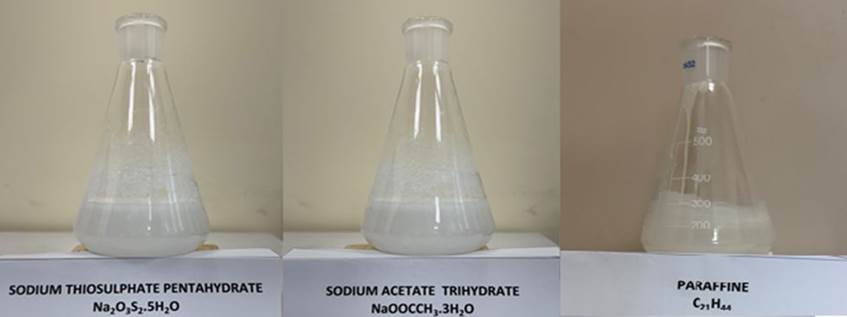
Fig. 1. Materials studied
The experiment was conducted under laboratory conditions to compare the thermal behavior of the three PCMs under the same conditions. The following equipment was used for the experimental setup:
- glass flasks with the same volume and geometry.
- electric hotplate with adjustable power.
- thermal imaging camera for non-contact measurement and recording of the temperature field in real time.
- electronic scale to ensure equal amounts of material.
Equal amounts of 250 ml were prepared from each PCM, and the mass was determined with an electronic scale in order to minimize errors associated with the different densities of the materials (Figure 2).
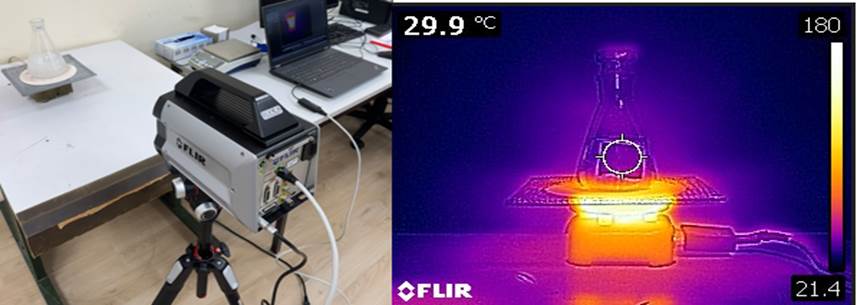
Fig. 2. Experimental setup
To ensure comparability of the results, all experiments were conducted under identical laboratory conditions, using the same sample volume, flask geometry and heating conditions.
Infrared thermography was performed using a FLIR X6802sc thermal imaging camera. The manufacturer specifies a temperature measurement accuracy of ±1 °C or ±1% of the reading under calibrated conditions.
The flasks are positioned on the hotplate in such a way as to ensure the most uniform heat exchange conditions. Because PCM charging/discharging behavior is highly sensitive to boundary conditions and heat transfer area, maintaining consistent geometry and heating conditions is essential for a reliable comparison of materials [14].
2.3 Heating process
Figure 3 presents the temperature behavior of the three phase-change materials when heated from room temperature (about 30 °C) to approximately 75–80 °C.
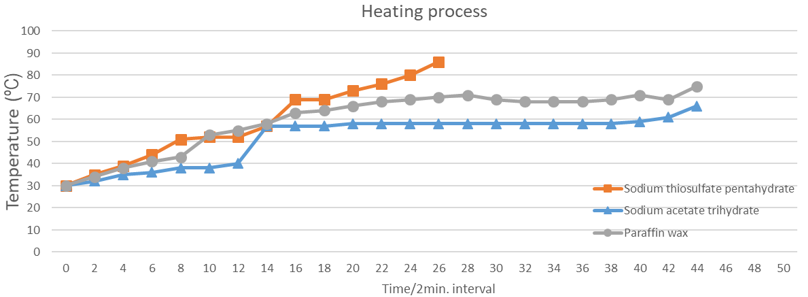
Fig. 3. Heating process
Paraffin demonstrates a smooth and uniform increase in temperature throughout the considered interval. In the initial stage of heating, the temperature increases uniformly from 30 °C to about 53 °C. In the temperature range of 55–58 °C, a slowdown in the heating process is observed, which corresponds to the phase transition from solid to liquid state. Melting occurs in a relatively wide temperature range, without a clear plateau, which is characteristic of this material. After complete melting, the temperature increases again smoothly, without sudden changes, which indicates stable and homogeneous heat transfer in the volume of the material.
Sodium acetate trihydrate is characterized by clearly defined heating stages. In the initial interval (0–12 min) the temperature rises moderately from 30 °C to about 40 °C. After reaching the phase transition temperature, a clearly defined and prolonged temperature plateau of about 57–58 °C is established, which persists for more than 20 min. This plateau is directly related to the absorption of the latent heat of fusion and shows a high capacity for accumulating thermal energy at an almost constant temperature. After the phase transition is completed, the temperature of the material begins to increase again.
In the case of sodium thiosulfate pentahydrate, the temperature initially increases gradually, similar to the other materials studied. During the phase transition, a sharper increase in temperature is observed compared to paraffin and sodium acetate trihydrate. This behavior is associated with the formation of liquid regions in the material and the release of water crystallization, which improves heat transfer in individual areas of the sample. As a result, the temperature increases faster compared to the other two materials. After the phase transition occurs, the temperature continues to increase during the rest of the heating process, which indicates that the material does not go through a prolonged period of temperature stabilization, characteristic of sodium acetate trihydrate.
The comparative analysis of the temperature curves clearly shows the differences in the thermal behavior of organic and inorganic PCM. Paraffin is characterized by smooth and stable heating, sodium acetate trihydrate - by a clearly expressed and prolonged phase transition at an almost constant temperature, and sodium thiosulfate pentahydrate - by sharper local effects when reaching the melting temperature. The observed thermal characteristics determine the behaviour of the materials in real operation and consider when choosing them for applications in thermal energy storage systems.
2.4 Cooling process
The cooling process of the three studied phase-change materials (PCMs) shows distinct differences in the temperature profiles, determined both by the release of sensible heat and by the distinctions of crystallization and phase transition. Figure 4 shows the change in temperature over an interval of 2 minutes, with all samples initially observing a smooth decrease in temperature from the order of 77–66°C to 55–50°C, typical of cooling without a phase transition. After this stage, the behaviour of the materials differs significantly.
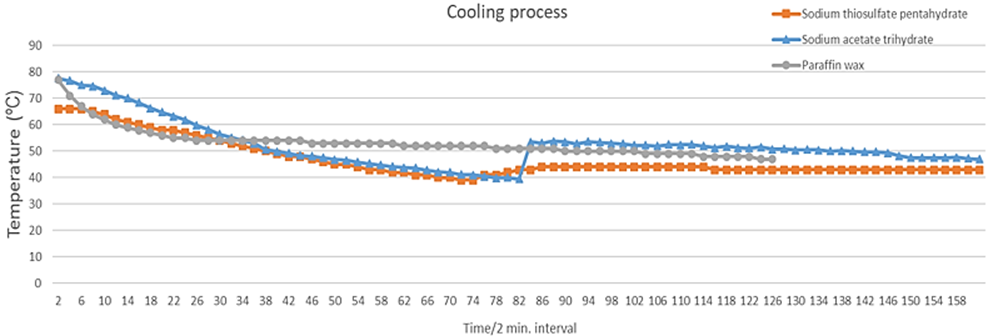
Fig. 4. Cooling process
In the case of sodium acetate trihydrate, pronounced supercooling is observed, as the temperature drops to a minimum of about 39.5°C without crystallization being observed, the material remaining in a liquid state below the phase transition temperature. To initiate the phase transition and ensure reproducibility, a crystal of the same material was added to the sample, acting as a crystallization nucleus. This is consistent with established approaches for mitigating supercooling in salt-hydrate PCMs through nucleation promotion strategies [15]. After its addition, a characteristic sharp temperature jumps to approximately 53–54°C was recorded, followed by a prolonged hold in the range of 52–54°C. This behavior is typical of a short-term increase (or hold) of temperature at the onset of crystallization, caused by the release of latent heat, after which the temperature continues to decrease again as the already solidified material cools.
Similar to sodium acetate, sodium thiosulfate pentahydrate also shows supercooling, with the temperature reaching around 39°C while the material remains liquid. Therefore, crystallization was initiated by adding a crystal of the corresponding material. After the onset of the phase transition, the temperature curve shows stabilization and a temperature plateau around 44°C for a significant time interval, which is associated with the release of latent heat during crystallization. Compared to NaCH₃COO·3H₂O, the phase transition of Na₂S₂O₃·5H₂O occurs at a lower temperature and with a more moderate recalescence, which is indicative of different crystallization kinetics and a different temperature difference between melting and solidification.
The cooling graph clearly distinguishes the behavior of organic and inorganic PCM. Paraffin cools smoothly and solidifies in a wider temperature range, while salt hydrates (NaCH₃COO·3H₂O and Na₂S₂O₃·5H₂O) demonstrate supercooling and remain liquid below the phase transition temperature, therefore crystallization is initiated with a crystal of the respective material. After the start of crystallization, latent heat release is observed in both salt hydrates, expressed as temperature retention or short-term increase.
The paraffin demonstrates a smooth and stable cooling, without sharp temperature anomalies. A clear plateau is formed in the temperature range around 54°C, indicating that at this temperature intense solidification and latent heat release occur, which temporarily compensates for the cooling. The observed temperature retention in a close range (approximately 54–53°C) is indicative of a wider temperature range of phase transition, typical of organic PCMs, in which crystallization occurs gradually.
3 Results and discussion
3.1 Thermal behavior during heating and cooling
For the three studied PCMs, temperature-time dependences are presented, allowing a direct comparison of the dynamics of heat transfer and phase transition. The results show different heating and cooling rates, as well as different degrees of temperature stabilization in the phase transition zone. Paraffin is characterized by smooth temperature curves and a transition in a wider temperature range around 55–58°C, while NaCH₃COO·3H₂O demonstrates the most pronounced temperature stabilization during melting (plateau around 57–58°C). In salt hydrates, supercooling is observed during cooling, which affects the moment of latent heat release; after crystallization initiation, NaCH₃COO·3H₂O releases energy in the range ~52–54°C, and Na₂S₂O₃·5H₂O – around ~44°C. On this basis, the temperature range of the phase transition and its correspondence to the operating temperatures of hot water storage systems are assessed.
3.2 Comparison of main parameters and summary of results
For summary and quantitative comparison, a table was prepared with the main indicators from the experiment and the reference properties of the materials: thermal conductivity (as a factor for heat transfer rate), latent heat, melting time and solidification/cooling time (or plateau time in the case of a phase transition).The latent heat and density values presented in Table 2 were obtained from literature sources and were used for comparative purposes. Additionally, an assessment of the accumulated latent energy for each material was performed based on reference thermophysical values at the same volume of 250 mL (Table 2).
Table 2. Thermo-physical properties and experimental indicators of the investigated PCMs (V = 250 mL)
|
Parameter |
Paraffin |
Na2S2O3.5H2O |
NaCH3COO.3H2O |
|
Melting temperature Tm (oC) |
55-58 |
~48 |
57-58 |
|
Solidification plateau Ts(oC) |
~54-53 |
~44 |
~52-54 |
|
Supercooling ΔT (oC) |
~0 |
~9 |
~18,5 |
|
Latent heat λ (kJ/kg) |
150-210 |
200-250 |
260-290 |
|
Density ρ (kg/m3) |
770-900 |
1700-1800 |
1450-1500 |
|
Latent heat stored for 250 ml Qlat (kJ) |
29-47 |
85-113 |
94-109 |
|
Melting duration Δtmelt (min) (experimental) |
2 |
<2 |
26 |
|
Solidification duration Δtsolid (min) (experimental) |
34 |
28 |
30 |
The obtained values for Qlat from (Table 2) show that, for equal volume, salt hydrates accumulate significantly more latent energy than paraffin, which is a direct consequence of their higher density and larger λ. The experimental times Δtmelt and Δtsolid show how long the material maintains a temperature close to the transition temperature, i.e. to what extent the phase change occurs as a clearly expressed “thermal buffer”. For paraffin waxes, the effective phase transition temperature is often better described as a range, which is important when interpreting heating/cooling curves and ‘plateau’ duration in practical thermal energy system applications [16]. In this way, the plateau times do not only describe the energy potential, but also the practical behavior during operation – whether the accumulation and release of heat are realized smoothly and stably in the operating temperature range of the hot water storage system.
The results presented in Table 2 were obtained under controlled laboratory conditions using glass flasks with identical geometry and volume. Glass was selected to provide uniform and chemically inert test conditions for all investigated materials. In practical thermal energy storage systems, however, the PCM is usually contained in metallic or polymeric vessels, which can affect the heat transfer rate during charging and discharging. Compared to the glass flasks used in this study, stainless steel containers are expected to provide more efficient heat transfer due to their higher thermal conductivity, whereas polymeric containers may lead to slower heat transfer and longer charging and discharging times. The exact melting and solidification times may change in real thermal energy storage systems. However, the main trends observed in this study, including the differences between the PCMs investigated are expected to remain unchanged. Therefore, the results obtained can be used as a basis for the preliminary selection of PCMs for low-temperature thermal energy storage and hot water storage applications.
Another important factor for practical application is the cyclic stability of hydrated salts. Although the present study focuses on a single heating and cooling cycle, the observed behavior indicates possible stability limitations related to supercooling and crystallization control. Sodium acetate trihydrate and sodium thiosulfate pentahydrate both showed supercooling during cooling, which suggests that repeated operation may require nucleating agents or other stabilization measures. In hydrated salts, phase separation may also occur after multiple cycles due to non-uniform melting and crystallization, which can gradually reduce the effective heat storage capacity. Therefore, for practical buffer tank applications, further cyclic testing is necessary to evaluate long-term stability and phase separation effects.
In the present study, crystallization of sodium acetate trihydrate and sodium thiosulfate pentahydrate was initiated by adding a small crystal of the same material. This method is convenient under laboratory conditions but is not practical for automated thermal energy storage systems. In real applications, supercooling can be reduced by incorporating nucleating agents directly into the PCM. Additives such as borax and graphite are commonly used for this purpose because they promote crystallization and improve the repeatability of the charging and discharging processes. Such approaches may improve the operational reliability of PCM-based hot water storage systems.
4 Conclusions
The conducted study compares the thermal behavior and main thermophysical characteristics of three phase-change materials – paraffin, Na₂S₂O₃·5H₂O and NaCH₃COO·3H₂O – in a temperature range suitable for heat storage systems for water heating. Combining experimental temperature-time dependences with quantitative estimates of the latent stored energy allows for an assessment of both the energy potential and the practical reliability of the materials under cyclic operation.
The results show that at equal volume (250 mL) salt hydrates provide a significantly higher latent energy capacity compared to paraffin, which makes them more efficient in terms of compactness and storage potential. At the same time, the experiment confirms that the organic PCM (paraffin) is distinguished by the most predictable behavior during heating and cooling and the absence of supercooling, which is an important factor for reliable operation without additional measures to stabilize the phase transition. Of the two salt hydrates, NaCH₃COO·3H₂O demonstrates better temperature compliance with the regime of hot water storage systems (stable zone around 57–58°C during melting and 52–54°C during crystallization), but exhibits significant supercooling, which requires controlled crystallization for guaranteed energy release. Na₂S₂O₃·5H₂O also exhibits supercooling, and latent heat release occurs at a lower temperature (~44°C), making it more suitable for preheating applications.
The choice of PCM for hot water storage systems should be determined by the priorities of the application – whether the maximum amount of stored energy in a minimum volume is sought, or more stable and predictable operation over multiple thermal cycles. Paraffin is a good choice when stability and repeatability are sought because it operates predictably and without problems with supercooling. The salt hydrates NaCH₃COO·3H₂O and Na₂S₂O₃·5H₂O can store more energy in the same volume, but for reliable operation, measures are usually needed to promote crystallization and reduce the effect of supercooling. Future research includes the investigation of stabilizing additives, measures to improve heat transfer, and longer cyclic tests to evaluate the long-term durability of the materials.
Acknowledgements
This research was financially supported by the Bulgarian National Science Fund under Grant No. KP-06-M87/6/09.07.2025 for the project “Thermodynamic and structural analyses of phase change materials for thermal energy storage”.
References
- Kassem, M. A., & Moscariello, A. (2025). Exploring heat storage: Innovations, risks, and future directions for sustainable energy. International Journal of Sustainable Energy, 44(1), 2513328. https://doi.org/10.1080/14786451.2025.2513328
- Gurler, T., Idowu, T. A., Yasir, S., Hussaini, Z., & Sansom, C. (2025). Development of a new PVt/PCM system for heating and power. SolarPACES Conference Proceedings, 3, 2511. https://doi.org/10.52825/solarpaces.v3i.2511
- Rehman, O. A., Palomba, V., Frazzica, A., & Cabeza, L. F. (2021). Enabling technologies for sector coupling: A review on the role of heat pumps and thermal energy storage. Energies, 14(24), 8195. https://doi.org/10.3390/en14248195
- Jeong, J., Jung, H. S., Lee, J. W., & Kang, Y. T. (2023). Hybrid cooling and heating absorption heat pump cycle with thermal energy storage. Energy, 283, 129027. https://doi.org/10.1016/j.energy.2023.129027
- Dutil, Y., Rousse, D. R., Salah, N. B., Lassue, S., & Zalewski, L. (2011). A review on phase-change materials: Mathematical modeling and simulations. Renewable and Sustainable Energy Reviews, 15(1), 112–130. https://doi.org/10.1016/j.rser.2010.06.031
- Mustapha, A. N., Onyeaka, H., Omoregbe, O., Ding, Y., & Li, Y. (2021). Latent heat thermal energy storage: A bibliometric analysis explicating the paradigm from 2000–2019. Journal of Energy Storage, 33, 102027. https://doi.org/10.1016/j.est.2020.102027
- Sharma, R. K., Ganesan, P., Tyagi, V. V., & Metselaar, H. S. C. (2015). Developments in organic solid–liquid phase change materials and their applications in thermal energy storage. Energy Conversion and Management, 95, 193–228. https://doi.org/10.1016/j.enconman.2015.01.084
- Herawan, S. G., Yemima, S., Saputra, A. N. F., & Akop, M. Z. (2025). Comparative thermal study of battery components under beeswax and paraffin PCM configurations. E3S Web of Conferences, 664, 02001. https://doi.org/10.1051/e3sconf/202566402001
- Cabeza, L. F., Castell, A., Barreneche, C., de Gracia, A., & Fernández, A. I. (2011). Materials used as PCM in thermal energy storage in buildings: A review. Renewable and Sustainable Energy Reviews, 15(3), 1675–1695. https://doi.org/10.1016/j.rser.2010.11.018
- Sharma, A., Raaj, R. V., Singh, S., & Kothadia, H. (2025). Inducing and controlling supercooling in industrial-grade sodium acetate trihydrate for long-term PCM-based thermal energy storage systems. Energy, 325, 136164. https://doi.org/10.1016/j.energy.2025.136164
- Fu, W., Zou, T., Liang, X., Wang, S., Gao, X., Zhang, Z., & Fang, Y. (2019). Characterization and thermal performance of microencapsulated sodium thiosulfate pentahydrate as phase change material for thermal energy storage. Solar Energy Materials and Solar Cells, 193, 149–156. https://doi.org/10.1016/j.solmat.2019.01.007
- Martinopoulos, G., Gkaidatzis, P. A., Jimeno, L., Belda González, A., Bakalis, P., Meramveliotakis, G., Gkountas, A., Tarsounas, N., Ioannidis, D., Tzovaras, D., & Nikolopoulos, N. (2026). Integrated control of hybrid thermochemical–PCM storage for renewable heating and cooling systems in a smart house. Electronics, 15(2), 279. https://doi.org/10.3390/electronics15020279
- Junaid, M. F., Rehman, Z. U., Čekon, M., Čurpek, J., Farooq, R., Cui, H., & Khan, I. (2021). Inorganic phase change materials in thermal energy storage: A review on perspectives and technological advances in building applications. Energy and Buildings, 252, 111443. https://doi.org/10.1016/j.enbuild.2021.111443
- Bruno, F., Belusko, M., Liu, M., & Tay, N. H. S. (2015). Using solid–liquid phase change materials (PCMs) in thermal energy storage systems. In L. F. Cabeza (Ed.), Advances in thermal energy storage systems (pp. 201–246). Woodhead Publishing. https://doi.org/10.1533/9781782420965.2.201
- Ye, L., Xie, N., Lan, Y., Niu, J., Deng, S., Gao, X., Fang, Y., & Zhang, Z. (2022). Preparation and thermal performance enhancement of sodium thiosulfate pentahydrate–sodium acetate trihydrate/expanded graphite phase change energy storage composites. Journal of Energy Storage, 50, 104074. https://doi.org/10.1016/j.est.2022.104074
- He, B., Martin, V., & Setterwall, F. (2004). Phase transition temperature ranges and storage density of paraffin wax phase change materials. Energy, 29(11), 1785–1804. https://doi.org/10.1016/j.energy.2004.03.002
Conflict of Interest Statement
The authors declare no conflict of interest.
Author Contributions
Data Availability Statement
The datasets generated and analyzed during the current study are available from the corresponding author upon reasonable request.
Supplementary Materials
There are no supplementary materials to include.