Volume 24 article 1343 pages 416-424
Received: Apr 10, 2025 Accepted: May 28, 2026 Available Online: Aug 03, 2026 Published: Aug 17, 2026
DOI: 10.5937/jaes0-58138
DEVELOPMENT OF SCARA ROBOT ARM COMBINED WITH VACUUM SUCTION HEAD
Abstract
This study presents the design, fabrication, and experimental validation of a compact SCARA robot arm integrated with a vacuum suction head for lightweight pick-and-place applications. The prototype consists of one vertical prismatic joint and two planar revolute joints, combined with a dual vacuum suction end-effector. Forward and inverse kinematic models were developed to determine the relationship between joint variables and end-effector position, while dynamic considerations were used to support the mechanical design process. The fabricated prototype was tested using a cuboid object with a mass of approximately 200 g and dimensions of 100 × 30 × 50 mm. The robot achieved a maximum horizontal displacement of 446 mm and a maximum vertical displacement of 178 mm. Experimental results confirmed the feasibility of the proposed low-cost SCARA prototype for basic lightweight pick-and-place tasks in laboratory-scale and small-scale automation applications.
Highlights
- Developed a SCARA robot arm integrated with a dual vacuum suction head for lightweight pick-and-place applications.
- Established kinematic and dynamic models to support mechanical design and actuator selection of robot prototypes.
- Fabricated and experimentally validated the prototype, achieving stable object grasping, transfer, and release.
- Demonstrated a compact, low-cost robotic system suitable for laboratory automation, education, and small-scale industrial tasks.
Keywords
Content
1 Introduction
SCARA robots have been widely used in repetitive manufacturing and assembly operations because of their simple mechanical structure, high repeatability, and rapid planar motion capability. Recent studies have reported different SCARA-based robotic systems for industrial and manufacturing applications, including disassembly tasks, manufacturing processes, cooperative manipulation, motor reliability evaluation, and the design of compact 3-DOF robotic mechanisms [1–5]. These studies confirm that SCARA robots remain an important robotic configuration for applications requiring fast horizontal motion, simple vertical positioning, and reliable repetitive operation.
In practical applications, SCARA and other serial robotic manipulators have been applied to packaging, material handling, agricultural automation, and electronic manufacturing. Robotic systems have been investigated for fresh produce handling in pack houses [6], automated packaging processes [7], and electronics manufacturing applications [8]. In the agricultural sector, SCARA-type manipulators and related robotic systems have also been developed for farm applications, harvesting, and object-picking tasks [9–13]. In addition, SCARA-based robotic systems have been studied for screw removal and disassembly operations, demonstrating their suitability for repetitive manipulation tasks in both manufacturing and recycling processes [14, 15].
Among the different applications of SCARA robots, pick-and-place operation is one of the most common because the combination of planar revolute motion and vertical displacement provides a simple and efficient manipulation strategy. Previous studies have addressed gripper design and robotic arm selection for pick-and-place automation [16], performance optimization of SCARA robots in pick-and-place tasks [17], trajectory tracking control for repetitive pick-and-place operations [18], and optimal strategies for multi-robot pick-and-place systems [19]. More recent research has also explored the natural motion of SCARA-like manipulators and simulation-based development of pick-and-place robotic arms [20, 21]. These works indicate that the design of the mechanical structure, end-effector, trajectory planning, and experimental validation are all important factors in developing practical pick-and-place systems.
Although commercial SCARA robots provide high speed, high accuracy, and reliable industrial performance, their cost and system complexity may limit their use in educational laboratories, small-scale automation systems, and prototype development environments. In such cases, a compact and low-cost robotic platform is still valuable, especially when it allows students and engineers to understand the complete development process, including mechanical design, kinematic modeling, fabrication, and experimental testing. In addition, for lightweight objects with simple geometric shapes, a vacuum suction end-effector can provide a simpler handling solution than a complex mechanical gripper, particularly when the task only requires picking, transferring, and releasing objects between predefined positions.
Several previous works have focused on the design, kinematic modeling, dynamic analysis, simulation, and control of SCARA robots and robotic arms. However, many studies emphasize either theoretical modeling, simulation, or control algorithms, while fewer papers present a complete development workflow from mechanical design and kinematic analysis to physical fabrication and experimental validation of a low-cost SCARA prototype. The authors’ previous studies also investigated lightweight pick-and-place robotic arm prototypes and structural analysis of robotic arms [22–23]. Building upon these related works, the present study focuses specifically on the development of a compact SCARA robot arm combined with a vacuum suction head for lightweight pick-and-place applications.
The objective of this study is to design, fabricate, and experimentally evaluate a 3-DOF SCARA robot arm integrated with a vacuum suction mechanism. The proposed prototype consists of one vertical prismatic joint driven by a lead-screw mechanism and two planar revolute joints driven by belt transmission. A dual vacuum suction head is used as the end-effector to pick and release cuboid objects at predefined positions. Forward and inverse kinematic models are established to determine the relationship between joint variables and end-effector position, while dynamic considerations are used to support the mechanical design process.
The main contribution of this work is not the development of a new SCARA theory, but the realization and validation of an integrated design–modeling–fabrication–testing workflow for a compact and low-cost SCARA robot prototype. The fabricated system is tested using a cuboid object weighing approximately 200 g. The experimental results demonstrate the feasibility of the proposed design for lightweight pick-and-place operation and provide a practical basis for further development of laboratory-scale and small-scale automation systems.
2 Materials and methods
2.1 Kinematic modeling
The proposed SCARA robot prototype consists of one vertical prismatic joint and two planar revolute joints. The vertical joint provides motion along the z-axis, while the two revolute joints generate the horizontal motion of the end-effector in the xOy plane. The generalized joint vector is defined as
where d₁ is the vertical displacement of the prismatic joint, and θ₂ and θ₃ are the rotation angles of the second and third joints, respectively. The geometric parameters of the robot are denoted by L₁ and L₂, corresponding to the lengths of the two planar links.
The Denavit-Hartenberg parameters used for kinematic formulation are given in Table 1.
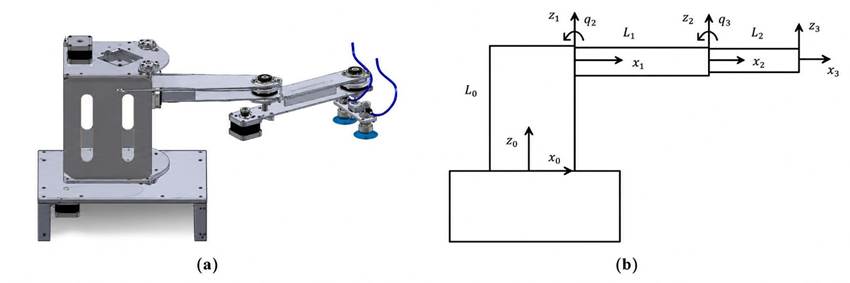
Fig. 1. SCARA robot arm prototype model
Table 1. Denavit-Hartenberg parameters of the SCARA robot
|
Link i |
aᵢ |
αᵢ |
dᵢ |
θᵢ |
|
1 |
0 |
0 |
d₁ |
0 |
|
2 |
L₁ |
0 |
0 |
θ₂ |
|
3 |
L₂ |
0 |
0 |
θ₃ |
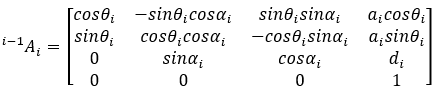
The general Denavit-Hartenberg transformation matrix between two consecutive coordinate frames is expressed as
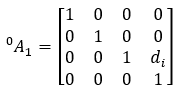
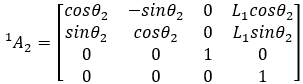
Based on the DH parameters in Table 1, the transformation matrices are obtained as
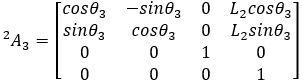
The homogeneous transformation matrix from the base frame to the end-effector frame is then
or
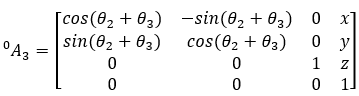
where the end-effector position is determined by
Equations (8)-(10) represent the forward kinematic model of the SCARA robot. They are used to calculate the end-effector position from the given joint variables.
2.2 Inverse kinematic modeling
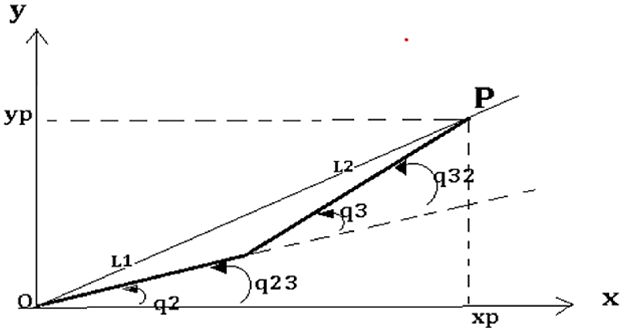
Fig. 2. Inverse kinematic diagram
The inverse kinematic problem determines the joint variables d₁, θ₂, and θ₃ corresponding to a desired end-effector position P (xP, yP, zP). For the vertical motion, the prismatic joint displacement is directly obtained as
For the planar motion, the distance from the base axis to the target point is defined as
Using the geometric relationship of the two-link planar mechanism, the third joint angle is calculated as
The second joint angle is then obtained from
Equations (11)-(15) provide the inverse kinematic solution used to determine the required joint configuration for a predefined pickup or release position. In practice, the selected solution must satisfy the mechanical limits of the joints and the reachable workspace of the prototype.
2.3 Dynamic considerations
The dynamic analysis was performed to support the mechanical design process and to estimate the generalized forces and moments acting on the robot joints during motion. The objective of this section is not to develop an advanced dynamic controller, but to provide a theoretical basis for evaluating the load requirements of the prototype.
The generalized coordinate vector is defined as
The Lagrange-Euler formulation is expressed as
where τᵢ is the generalized force or torque corresponding to qᵢ, and L is the Lagrangian of the system:
Here, K is the total kinetic energy, and P is the total potential energy of the robot system. The total kinetic and potential energies are written as
For the vertical prismatic joint, the kinetic and potential energies of the first moving link can be expressed as
where m₁ is the mass associated with the vertical moving link and g is the gravitational acceleration.
For the planar links, kinetic energy includes both translational and rotational components. In general form, the kinetic energy of each planar link can be written as
where mᵢ, Iᵢ, (xcᵢ, ycᵢ, zcᵢ), and ωᵢ are the mass, moment of inertia, center-of-mass coordinates, and angular velocity of link i, respectively. The potential energy of each link is
because the planar links move vertically together with the prismatic joint.
Using Eqs. (17)-(24), the generalized force of the vertical joint and the torques of the two revolute joints can be obtained as
where τ₁ represents the driving force required for the vertical prismatic joint, while τ₂ and τ₃ represent the driving torques required for the planar revolute joints.
This dynamic formulation was used to support the selection of mechanical transmission components and actuators for the fabricated prototype. Since the main objective of this study is the design, fabrication, and experimental validation of a low-cost SCARA robot prototype, detailed dynamic identification and closed-loop torque control are considered outside the scope of the present work.
2.4 Orientation of the vacuum suction head
The end-effector consists of a dual vacuum suction head. Since the suction head must be aligned with the desired pickup or release direction, its orientation angle is determined based on the target point in the xOy plane.
Let the two suction points be denoted as
The angle between the target direction and the x-axis is calculated as
If α < 0, the suction points are exchanged and α is recalculated to ensure a feasible orientation of the suction head. The orientation angle of the suction head is then determined by
where θ₄ is the orientation angle of the suction head. This calculation allows the vacuum suction head to be oriented appropriately during the pick-and-place operation.

Fig. 3. Projection in Oxy coordinate system including angle of suction part
3 Results and discussions
3.1 Experimental results
The fabricated SCARA prototype was tested using a cuboid object with a mass of approximately 200 g and dimensions of 100 × 30 × 50 mm. The pickup and release positions were predefined by the user. For each target position, the inverse kinematic model was used to determine the corresponding joint variables. The robot then executed a point-to-point pick-and-place sequence consisting of four main steps:
- moving to the pickup position.
- activating the vacuum suction head to grasp the object.
- transporting the object to the target position.
- releasing the object by deactivating the vacuum suction system.
The testing procedure was used to evaluate whether the fabricated prototype could successfully perform the required lightweight pick-and-place task. Quantitative performance indicators, including payload, working range, success rate, cycle time, and positioning deviation, were recorded and discussed in the Results section.
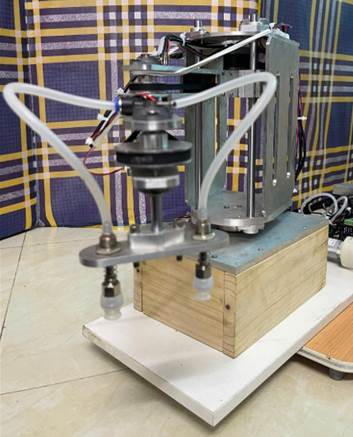
Fig. 4. Fabricated prototype of the SCARA robot arm
The fabricated SCARA robot arm prototype is shown in Figure 4. The main technical specifications of the prototype are summarized in Table 2. When the links are fully extended, the robot has an overall length of 655.5 mm and a height of 437 mm. The prototype consists of one vertical prismatic joint and two planar revolute joints. The vertical motion is driven by a lead-screw mechanism, while the planar motion is generated by belt-driven revolute joints. A dual vacuum suction head is mounted at the end-effector for picking and releasing lightweight cuboid objects.
Table 2. Main technical specifications of the fabricated SCARA robot prototype
|
Parameter |
Value |
|
Degree of freedom |
3 |
|
Joint configuration |
1 prismatic joint + 2 revolute joints |
|
Overall length at fully extended configuration |
655.5 mm |
|
Overall height |
437 mm |
|
Prototype mass |
8 kg |
|
Length of link 2 |
231.3 mm |
|
Length of link 3 |
214.9 mm |
|
Length of suction module |
110 mm |
|
Maximum rotation of suction module |
180° |
|
Maximum horizontal displacement |
446.2 mm |
|
Maximum vertical displacement |
178 mm |
|
Rated test payload |
200 g |
|
Test object size |
100 × 30 × 50 mm |
|
End-effector type |
Dual vacuum suction head |
To evaluate the functionality and basic performance of the fabricated prototype, repeated pick-and-place experiments were conducted using a rectangular cuboid object with a mass of approximately 200 g and dimensions of 100 × 30 × 50 mm. The pickup and release positions were predefined within the reachable workspace of the robot. For each trial, the robot first moved to the pickup position, activated the vacuum suction head to grasp the object, transported the object to the release position, and then deactivated the suction system to place the object at the target location.
The experimental sequence is shown in Figure 5. The main stages of the pick-and-place operation are combined into a single sequential figure for clearer presentation: the initial position, object transportation, and object release at the target position.

|
(a) |
(b) |
(c) |
Fig. 5. Experimental sequence of the pick-and-place test: (a) initial position; (b) object transportation using the vacuum suction head; and (c) object release at the target position
The experimental results demonstrate that the fabricated SCARA robot prototype can perform the intended lightweight pick-and-place task using a vacuum suction end-effector. The robot successfully handled a cuboid object with a mass of approximately 200 g and dimensions of 100x30x50 mm. The measured performance indicators, including success rate, cycle time, positioning deviation, and repeatability, provide a more quantitative basis for evaluating the effectiveness of the proposed system.
The main strength of the developed prototype is its simple and compact mechanical configuration. The combination of a vertical lead-screw mechanism and two belt-driven planar revolute joints provides sufficient motion capability for basic pick-and-place operations. In addition, the dual vacuum suction head enables simple object grasping and releasing without requiring a complex mechanical gripper. This makes the proposed system suitable for educational laboratories, small-scale automation, and prototype development environments.
Compared with commercial SCARA robots, the proposed prototype is not intended to compete in terms of industrial-grade speed, payload, or positioning accuracy. Instead, its practical value lies in providing a low-cost and easily fabricated platform that demonstrates the complete workflow of mechanical design, kinematic modeling, fabrication, and experimental testing. This is particularly useful for engineering education and laboratory-scale automation studies.
However, several limitations should also be acknowledged. First, the payload capacity of the current prototype is limited to lightweight objects. Second, experimental validation was performed using one object shape and one payload condition. Third, the control strategy used in the present study is mainly point-to-point positioning, while advanced closed-loop trajectory control and dynamic compensation were not implemented. Finally, the current experimental evaluation does not include long-term durability testing or operation under high-speed industrial conditions.
Future work will focus on improving the control system, increasing the number of experimental trials, testing different object shapes and surface materials, and evaluating the robot under different payload and speed conditions. Additional studies on closed-loop control, trajectory optimization, and suction-force stability will also be useful to improve the robustness and applicability of the developed system.
The research has achieved the goal of designing and manufacturing a SCARA robot with three degrees of freedom that can pick up and drop objects. By analyzing the structures of each link and joint of the robot, a manufacturing plan is then proposed. Reversible kinematics problems are also taken into account to determine the position of the robot at the time being considered as well as the coordinates of the position, direction and the joint sets of the arm. The manufactured prototype is capable of picking up a cuboid object weighing about 200 grams, with a maximum size of 100x30x50 mm, a maximum horizontal displacement of 446 mm, and a maximum vertical displacement of 178 mm. The results of the research have proposed a design and manufacturing plan for a prototype arm capable of picking up and dropping objects, which is a premise for the development of an industrial robot arm that can be applied in industry.
3.2 Discussion
The fabricated SCARA robot prototype was experimentally evaluated through a lightweight pick-and-place task using a cuboid object with a mass of approximately 200 g and dimensions of 100 × 30 × 50 mm. The pickup and release positions were predefined within the reachable workspace of the robot. For each trial, the corresponding joint variables were determined using the inverse kinematic model, and the robot executed a point-to-point sequence consisting of object pickup, transportation, and release using the dual vacuum suction head.
The experimental results confirmed that the prototype was able to perform the intended pick-and-place operation. The object was successfully grasped, transferred, and released at the target location without visible loss of suction during the movement. The maximum horizontal displacement of the prototype was 446.2 mm, while the maximum vertical displacement was 178 mm. These values indicate that the developed robot provides a suitable working range for laboratory-scale object transfer and small-scale automation tasks.
The mechanical configuration of the prototype contributed directly to its functional performance. The vertical lead-screw mechanism provided controlled lifting and lowering motion, while the two belt-driven planar revolute joints enabled horizontal movement between the pickup and release positions. The dual vacuum suction head also simplified the grasping mechanism by eliminating the need for a complex mechanical gripper. For lightweight cuboid objects with relatively flat surfaces, this suction-based end-effector provides a practical and simple solution for basic pick-and-place operation.
The main advantage of the proposed system is its compact and low-cost design. Compared with commercial SCARA robots, the developed prototype is not intended to compete in terms of industrial-grade speed, payload capacity, or positioning accuracy. Instead, its practical value lies in providing an easily fabricated robotic platform that integrates mechanical design, kinematic modeling, fabrication, and experimental testing in a complete workflow. Therefore, the system is suitable for educational laboratories, prototype development, and small-scale automation studies.
However, several limitations should be acknowledged. First, the current prototype was validated only for lightweight objects. Second, the experimental testing was conducted using one object geometry and one payload condition. Third, the implemented motion strategy was based mainly on point-to-point positioning, while advanced closed-loop trajectory control and dynamic compensation were not included. Finally, long-term durability, high-speed operation, and robustness under different surface conditions were not investigated in the present study.
Future work will focus on improving the control system, increasing the number of experimental trials, testing different object shapes and surface materials, and evaluating the robot under different payload and speed conditions. Further studies on closed-loop control, trajectory optimization, suction-force stability, and long-term operation will also be useful to improve the robustness and applicability of the developed system.
4 Conclusions
This study presented the design, fabrication, and experimental validation of a compact SCARA robot arm integrated with a vacuum suction head for lightweight pick-and-place applications. The proposed prototype consists of one vertical prismatic joint driven by a lead-screw mechanism and two planar revolute joints driven by belt transmission. Forward and inverse kinematic models were developed to determine the relationship between joint variables and end-effector position, while dynamic considerations were used to support the mechanical design and actuator-selection process.
The fabricated prototype achieved a maximum horizontal displacement of 446.2 mm and a maximum vertical displacement of 178 mm. The system was tested using a cuboid object with a mass of approximately 200 g and dimensions of 100 × 30 × 50 mm. The experimental results confirmed that the robot could perform the required lightweight pick-and-place task using the dual vacuum suction head.
The main contribution of this work is the realization of an integrated design–modeling–fabrication–testing workflow for a compact and low-cost SCARA robot prototype. The proposed system provides a practical platform for educational laboratories, prototype development, and small-scale automation applications. Nevertheless, the current study is limited to lightweight payloads, one object geometry, and point-to-point operation. Future work will focus on improving control performance, extending experimental validation to different payloads and object surfaces, and evaluating the long-term robustness of the system.
Acknowledgements
No external funding was received
References
- Núñez, F., Madrid, B., Chávez, J., & Madrid, M. J. (2024). SCARA robot arm for disassembly tasks. In 2024 9th International Conference on Control and Robotics Engineering (ICCRE) (pp. 216–221). IEEE. https://doi.org/10.1109/ICCRE61448.2024.10589757
- Dave, H. K., Chanpura, M. D., Kathrotiya, S. J., Patolia, D. D., Dodiya, D. D., & Kharva, P. S. (2022). Design, development and control of SCARA for manufacturing processes. In S. Kumar, J. Ramkumar, & P. Kyratsis (Eds.), Recent advances in manufacturing modelling and optimization (Lecture Notes in Mechanical Engineering). Springer. https://doi.org/10.1007/978-981-16-9952-8_47
- Urrea, C., et al. (2024). Enhancing adaptability and autonomy in cooperative selective compliance assembly robot arm robots: Implementation of coordination and rapidly exploring random tree algorithms for safe and efficient manipulation tasks. Applied Sciences, 14(15), 6804. https://doi.org/10.3390/app14156804
- Chen, M., et al. (2024). Lifetime prediction of permanent magnet synchronous motor in selective compliance assembly robot arm considering insulation thermal aging. Sensors, 24(12), 3747. https://doi.org/10.3390/s24123747
- Keskekçi, A. B., Bayrakçi, H. C., & Yilmaz, E. N. (2023). Design and manufacturing of a 3 DOF robot with additive manufacturing methods. In D. J. Hemanth et al. (Eds.), Smart applications with advanced machine learning and human-centred problem design (pp. 39–45). Springer Nature Switzerland. https://doi.org/10.1007/978-3-031-09753-9_4
- Mulholland, B. J., Panesar, P. S., & Johnson, P. H. (2024). The adoption of robotics in pack houses for fresh produce handling. The Journal of Horticultural Science and Biotechnology, 99(1), 9–19. https://doi.org/10.1080/14620316.2023.2269395
- Ventura, C. R., Bacilio, M. S., Zavaleta, L. G., Cornejo, J., & Palomares, R. (2024). Kinematic modeling of serial robotic manipulators to automate the packaging process of tuna cans. In 2024 Latin American Robotics Symposium (LARS) (pp. 1–6). IEEE. https://doi.org/10.1109/LARS64411.2024.10786435
- Bogue, R. (2023). The role of robots in the electronics industry. Industrial Robot: The International Journal of Robotics Research and Application, 50(5), 717–721. https://doi.org/10.1108/IR-05-2023-0115
- Roshanianfard, A., Mengmeng, D., & Nematzadeh, S. (2021). 4-DOF SCARA robotic arm for various farm applications: Designing, kinematic modelling, and parameterization. Acta Technologica Agriculturae, 24(2), 61–66. https://doi.org/10.2478/ata-2021-0011
- Roshanianfard, A., Mengmeng, D., & Nematzadeh, S. (2021). Dynamic modelling and motion control of a 4-DOF SCARA robotic arm for various farm applications. Acta Technologica Agriculturae, 24(3), 103–111. https://doi.org/10.2478/ata-2021-0018
- Xu, Z., et al. (2023). Realtime picking point decision algorithm of trellis grape for high-speed robotic cut-and-catch harvesting. Agronomy, 13(6), 1618. https://doi.org/10.3390/agronomy13061618
- Koirala, B., et al. (2024). Robotic button mushroom harvesting systems: A review of design, mechanism, and future directions. Applied Sciences, 14(20), 9229. https://doi.org/10.3390/app14209229
- Dibyanshu, Rajput, R. K. S., Pandey, S., Mathpal, T., & Kunwar, B. (2024). Advancing efficiency in agricultural automation: A kinematic model for a parallel 4-DoF SCARA system. In International Conference on Mathematical Modelling, Applied Analysis and Computation (ICMMAAC 2023). Springer Nature Switzerland. https://doi.org/10.1007/978-3-031-56307-2_13
- Liang, D., et al. (2024). Complete kinematics/dynamics modeling and performance analysis of a novel SCARA parallel manipulator based on screw theory. Journal of Mechanisms and Robotics, 16(10). https://doi.org/10.1115/1.4066200
- Szewczyk, R., et al. (2024). Uncertainty assessment of the screw removal system for robotic disassembly of hard disk drives during the recycling process. Acta Physica Polonica A, 146(4), 591–595. https://doi.org/10.12693/APhysPolA.146.591
- Shah, V., Gilke, N., Dhore, V., Phutane, C., & Kondhol, B. (2021). Design of gripper and selection of robotic arm for automation of a pick and place process. In S. Kumar & K. P. Rajurkar (Eds.), Advances in manufacturing systems (Lecture Notes in Mechanical Engineering). Springer. https://doi.org/10.1007/978-981-33-4466-2_10
- González-Palacios, M. A., Garcia-Murillo, M. A., & González-Dávila, M. (2021). A novel tool to optimize the performance of SCARA robots used in pick and place operations. Journal of Mechanical Science and Technology, 35, 4715–4726. https://doi.org/10.1007/s12206-021-0940-4
- Wu, G., Niu, B., & Li, Q. (2023). Trajectory tracking control of fast parallel SCARA robots with fuzzy adaptive iterative learning control for repetitive pick-and-place operations. Electronics, 12(24), 4995. https://doi.org/10.3390/electronics12244995
- Zhou, M., & Jiang, R. (2022). Optimal strategy for pick-and-place system with two robots. Journal of Physics: Conference Series, 2216(1), 012021. https://doi.org/10.1088/1742-6596/2216/1/012021
- Bruzzone, L., Verotti, M., & Fanghella, P. (2024). Exploiting the natural motion of a SCARA-like manipulator for pick-and-place tasks. In G. Rosati, A. Gasparetto, & M. Ceccarelli (Eds.), New trends in mechanism and machine science (Mechanisms and Machine Science, Vol. 165). Springer. https://doi.org/10.1007/978-3-031-67295-8_16
- Rooban, S., et al. (2022). Simulation of pick and place robotic arm using CoppeliaSim. In 2022 6th International Conference on Computing Methodologies and Communication (ICCMC) (pp. 1205–1209). IEEE. https://doi.org/10.1109/ICCMC53470.2022.9754013
- Tung, T. T., Anh, N. T., Quynh, N. X., & Minh, T. V. (2026). Simulation and experimental study of a lightweight pick and place robotic arm prototype. Journal of Integrated Science and Technology, 14(1), 1511. https://doi.org/10.62110/sciencein.jist.2026.v14.1511
- Tung, T. T., Anh, N. H., & Minh, T. V. (2023). Design and structure analysis of a prototype industrial robot arm. In Proceedings of the 2023 6th International Conference on Robot Systems and Applications. https://doi.org/10.1145/3655532.3655545
Conflict of Interest Statement
The authors declare that there is no conflict of interest regarding the publication of this paper.
Author Contributions
Data Availability Statement
No separate dataset was used or generated as part of this study. The supporting data are presented within the article.
Supplementary Materials
There are no supplementary materials associated with this study.