Volume 24 article 1371 pages: 796-804
Received: Sep 02, 2026 Accepted: Oct 13, 2026 Available Online: Nov 14, 2026 Published: Nov 17, 2026
DOI: 10.5937/jaes0-70586
EFFECT OF ALKALI-TREATED COCONUT COIR MAT LAMINATION ON THE FLEXURAL, TENSILE, AND WATER ABSORPTION BEHAVIOR OF PLYWOOD
Abstract
Natural fiber-reinforced wood composites are attracting interest as construction materials with a reduced reliance on synthetic reinforcement. Coconut coir is a widely available agricultural by-product with relatively low density, high toughness, and renewability, which makes it an interesting alternative reinforcement. This study examined 18 mm commercial plywood laminated with alkali-treated coconut coir fiber mats using bisphenol-A epoxy resin, in order to assess the effect of coir lamination on mechanical and moisture performance. Two configurations were studied: one-sided (OS) and both-sided (BS) lamination, with unlaminated plywood as the control. Static bending, tensile, and water absorption tests were carried out according to IS 1734 (Part 11):1983, IS 1734 (Part 9):1983, and IS 1734 (Part 6):1983, respectively, and the bending and tensile results (n = 4) were compared by one-way ANOVA with Tukey's test. Calculated on the total panel thickness, lamination lowered the modulus of elasticity (MOE) in both grain directions: by 15% (OS) and 19% (BS) along the grain, and by 28% (OS) and 46% (BS) across the grain. Because the across-grain direction was reduced more, the across/along MOE ratio fell from 1.59 for the control to 1.05 for the BS panel, so the random-mat coir layer reduced the anisotropy of the plywood rather than uniformly stiffening it. The BS panel retained its along-grain modulus of rupture (MOR) (−2%, not significant) but lost 18% across the grain, whereas the OS panel lost 39% along the grain. Tensile strength decreased in the BS panel by about 20% along and 22% across the grain, and in the OS panel by about 45% across the grain, the largest reduction (the along-grain reduction of 13% was not significant). Water absorption was lower in both laminated panels than in the control, by about 35% (OS) and 42% (BS) after 2 h and by about 36% (OS) and 43% (BS) after 24 h; the difference between OS and BS was small, which suggests that the continuous cured epoxy film is the likely main barrier. Any contribution of alkali treatment to fiber–matrix bonding is consistent with the literature but was not verified in this study. Although reinforcement is an agricultural by-product, the bisphenol-A epoxy matrix is petrochemical-based and not recyclable, so the environmental benefit is partial. The results suggest that coir lamination can modify the directional flexural behaviour and moisture uptake of plywood for furniture and interior applications, but it did not increase flexural modulus or strength on a section basis.
Highlights
- Alkali-treated coconut coir mats were successfully laminated onto commercial plywood using an epoxy matrix.
- Coir lamination generally reduced tensile strength, with losses depending on direction.
- Coir-epoxy lamination reduced water absorption but lowered flexural modulus.
Keywords
Content
1 Introduction
The construction industry is one of the biggest users of natural resources and a significant contributor to global greenhouse gas emissions and construction waste. There is therefore a growing focus on renewable and bio-based materials for use in buildings that will reduce their environmental impact without compromising their structural performance. The development of natural fiber-reinforced composites has become an attractive alternative to traditional synthetic fiber composites as they possess relatively good mechanical properties, lower embodied energy, are low in density, and are naturally renewable and biodegradable. The increased popularity of using them in the manufacture of building components such as wall panels, ceiling systems, insulation products, and interior furnishing materials points to the ever-rising demand for sustainable construction technologies [1–3].
Coconut coir was one of the natural fibers studied for engineering applications, which is an abundant by-product of coconut processing. India is one of the world's biggest producers of coconut coir, which facilitates its availability for value-addition applications. Coir has a relatively high amount of lignin (around 40-45%), which makes it very tough, resistant to microbial degradation, and comparatively less moisture-sensitive compared to many other lignocellulosic fibers. Due to these properties, coir is highly sought after for use in energy absorption, durability, and dimensional stability applications [4–6].
However, these advantages are limited by the fact that the fibers of coir are not compatible with polymer matrices due to the presence of surface waxes, hemicellulose, and other amorphous components. These hydrophilic components prevent adhesion between fiber and matrix, making stress transfer inefficient and the composite performance not ideal. Alkaline treatment (NaOH mercerization) of the fibers is one of the most widely used surface modification methods to enhance their interfacial bonding. The alkali treatment not only removes impurities but also makes the surface rougher, unravels the cellulose fibrils, and improves the mechanical interlocking between fibers and polymer matrices, resulting in better flexural and tensile properties [7–15].
Plywood is one of the most popular engineered wood products due to its excellent strength-to-weight ratio, dimensional stability, and ease of manufacture. However, the most important mechanical properties are determined by the outer veneer layers, which are subjected to the greatest tensile and compressive stresses when bending. According to classical laminate theory, reinforcing the outer surfaces can increase bending stiffness and strength with little added weight, provided the reinforcing layer is stiffer and stronger than the material it covers; a layer of lower modulus does not give this benefit. The flexural properties of fiber-reinforced laminated wood systems can be considerably enhanced by using suitable surface reinforcement [16–22].
While many studies have been conducted on coir-reinforced polymer composites and hybrid natural fiber laminates, very few studies have investigated the use of continuous alkali-treated coconut coir mats as a surface laminate of commercial plywood panels. Furthermore, the mechanical and moisture properties of plywood under single and double side lamination have not been fully explored for the reinforcement symmetry effect. It is crucial to ensure the effectiveness of these reinforcement configurations to produce an improved plywood product for interior building applications.
In view of this, the present work examines the mechanical and moisture properties of commercially available 18 mm plywood reinforced with alkali-treated coconut coir fiber mat with an epoxy resin matrix. Two types of lamination (one-side and both-side) were tested and compared against unreinforced plywood. Static bending, tensile strength, and water absorption tests were performed as per relevant BIS (IS 1734) to evaluate the effect of coir lamination on structural behavior. The study aims to assess whether an abundant agricultural by-product can serve as a surface reinforcement that modifies the mechanical and moisture performance of plywood used in construction. The epoxy matrix is petrochemical-based, so any sustainability benefit is limited to the reinforcement.
2 Materials and methods
2.1 Materials
Commercial 18 mm plywood sheets commonly used for interior and general construction applications were procured from a local timber supplier in Mangaluru, Karnataka, India. All plywood panels were obtained from the same manufacturing batch to minimise variations in material properties during testing. Coconut coir fiber mats were obtained from a coir processing unit in Kerala, India. The fibers were extracted from mature coconut husks using conventional retting and mechanical defibring processes before being processed into uniform non-woven mats suitable for lamination. A two-component epoxy adhesive system consisting of bisphenol-A epoxy resin and a polyamine hardener was used as the bonding matrix. The resin and hardener were mixed in the manufacturer's recommended weight ratio of 2:1 immediately before application.
2.2 Alkali treatment of coconut coir fiber
Before lamination, the coconut coir mats were subjected to alkaline surface treatment to improve fiber-matrix interfacial adhesion. The fiber mats were immersed in a 5 wt.% sodium hydroxide (NaOH) solution at room temperature for 4 h. After treatment, the fibers were thoroughly rinsed with distilled water until a neutral pH was achieved to remove residual alkali. The treated mats were subsequently dried in a laboratory oven at 60 °C for 24 h to eliminate absorbed moisture before lamination. Alkali treatment is reported to remove surface impurities, waxes, oils, and a portion of the hemicellulose and lignin from the fiber surface, increasing surface roughness and mechanical interlocking with epoxy matrices [7–11]. These effects were not characterized in the present study, and no untreated-coir group was included.
2.3 Preparation of coir-laminated plywood
Three types of specimens were prepared for this investigation (Fig.1):
- Conventional plywood: Commercial 18 mm plywood without reinforcement.
- One-side coir laminated plywood (OS): A single alkali-treated coir mat bonded to one face of the plywood.
- Both-side coir laminated plywood (BS): Alkali-treated coir mats bonded symmetrically to both faces of the plywood.
The epoxy adhesive was uniformly applied over the plywood surface using a hand roller before positioning the coir mat. Care was taken to ensure complete wetting of fibers and no air entrapment in the lay-up. Laminated panels were consolidated in a hydraulic cold press with a pressure of about 1 MPa for 24 h at ambient laboratory conditions to achieve uniform bonding. This was sufficient cure for handling and specimen cutting; ambient-cured epoxy typically needs several days for full crosslinking, and the cure state was not assessed. No separate post-cure step was applied; instead, the panels were stored at ambient laboratory conditions for about two months between pressing and testing, in addition to the 48 h conditioning (Section 2.4). After pressing, the laminated panels were cut into standard test specimens as per relevant Bureau of Indian Standards (BIS) standards
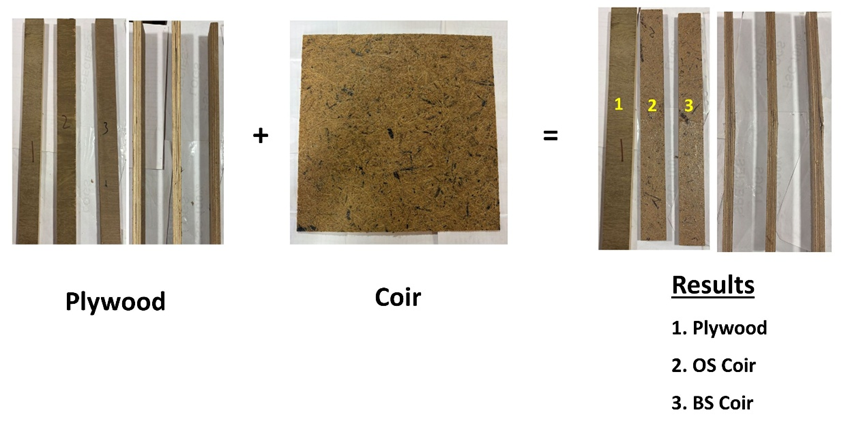
Fig. 1. Illustrating specimen preparation: raw plywood and coconut coir combined to produce the Conventional Plywood, OS Coir Reinforced Plywood, and BS Coir Reinforced Plywood, respectively
2.4 Conditioning of specimens
Before testing, all specimens were conditioned at a temperature of 20 ± 2 °C and relative humidity of 65 ± 5% for at least 48 h in accordance with standard laboratory practice. Conditioning ensured moisture equilibrium before mechanical and physical testing.
2.5 Mechanical testing
2.5.1 Static bending test
Static bending behavior was evaluated according to IS 1734 (Part 11):1983 using a Universal Testing Machine (UTM) equipped with a 50 kN load cell. A three-point bending configuration was employed with a constant span-to-thickness ratio of 20:1. The load was applied at a crosshead speed of 2 mm/min until failure. Modulus of elasticity (MOE) and Modulus of rupture (MOR) were calculated using equations 1 and 2, respectively.
Where P is the load in newton (N) at proportional limit, L is the span in mm, b is the width of the specimen in mm, h is the total thickness of the specimen in mm (18 mm for the plywood and approximately 19.5 mm for OS and 21 mm for BS, including a coir–epoxy layer of about 1.5 mm on each laminated face), P′ is the maximum load in N, and Δ is the deflection at proportional limit in mm.
2.5.2 Tensile test
Tensile strength was measured according to IS 1734 (Part 9):1983 using the same Universal Testing Machine. Dog-bone-shaped specimens (Type D, Fig.2: overall length 405 mm, grip width 50 mm, central width 12 mm, radius of the reduced section 305 mm) were cut from the full panel thickness and tested in both grain directions at a constant crosshead speed of 2 mm/min until fracture. The maximum load sustained before failure was used to calculate the tensile strength on the total cross-section of the specimen (thickness as in Section 2.5.1).
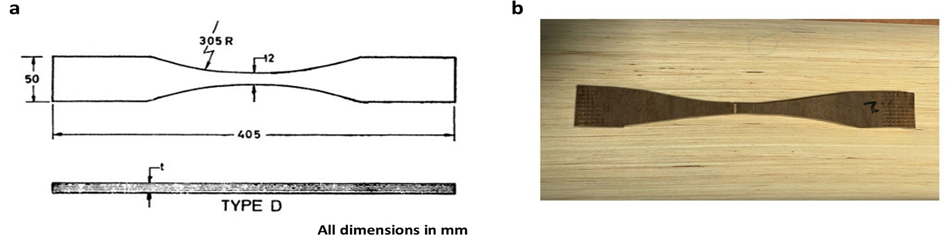
Fig. 2. Tensile strength testing: (a-b) dimensions with actual photograph of the specimen
2.6 Water absorption test
Water absorption behavior was determined following IS 1734 (Part 6):1983. Specimens measuring 150 mm × 50 mm (panel thickness) were used, and their cut edges were left unsealed. The specimens were initially oven dried, cooled to room temperature in a desiccator, and weighed to obtain the initial dry mass (W₀). The specimens were then completely immersed in distilled water maintained at 20 ± 1 °C. Mass measurements were recorded after 2 h and 24 h of immersion. The water absorption was calculated using equation 3, where W₀ is the initial dry mass, and Wₜ is the mass after immersion.
2.7 Experimental equipment
All mechanical testing was performed using a calibrated Universal Testing Machine (ASIAN, INDIA) equipped with a 50 kN load cell (Fig.3a and b). Water absorption experiments were carried out using a stainless-steel immersion tank (KEMI, INDIA) (Fig.3c and d), while specimen mass was measured using a precision electronic balance with an accuracy of ±0.01 g. All measuring equipment was calibrated prior to experimentation. The experimental results are reported as the mean ± standard deviation of four replicate specimens (n = 4) for each bending and tensile test condition. Water absorption was determined on a single specimen per configuration.
2.8 Statistical analysis
Differences among the control, OS, and BS panels were evaluated separately for each property and grain direction by one-way analysis of variance (ANOVA) with Tukey's post hoc test at a significance level of α = 0.05 (n = 4 per group). Statistical groupings in Figures 4 and 5 are indicated by lowercase letters (a, b, c, and ab) above the bars. Within each property and grain direction, means sharing at least one letter are not significantly different, whereas means with no letter in common differ significantly according to Tukey’s post hoc test at α = 0.05. A mean labelled “ab” does not differ significantly from means labelled “a” or “b”. These letters represent comparisons among the three plywood configurations within the same grain direction and should not be compared between grain directions or between properties. Exact p-values are reported in Section 3, and the terms “significant” and “significantly” are used only where p < 0.05. Water absorption was not analyzed statistically because a single specimen per configuration was tested.
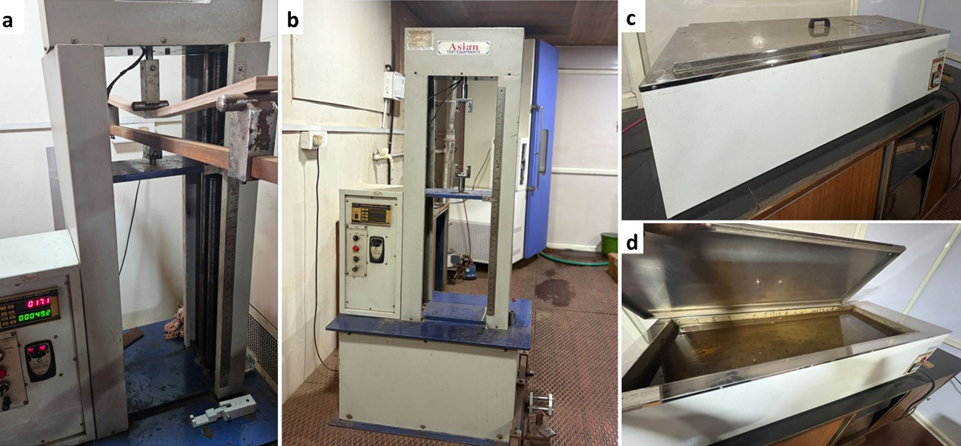
Fig. 3. Experimental testing equipment used in this study: (a–b) Universal Testing Machine (UTM) used for three-point bending and tensile strength evaluation of plywood specimens in accordance with IS 1734 (Part 11): 1983 and IS 1734 (Part 9): 1983 respectively; (c–d) stainless steel water immersion tank used for water absorption testing in accordance with IS 1734 (Part 6): 1983
3 Results and discussion
3.1 Flexural performance
The average flexural properties of the three plywood configurations are illustrated in Fig.4(a) and (b). Both the modulus of elasticity (MOE) and modulus of rupture (MOR) were evaluated in the longitudinal (along-grain) and transverse (across-grain) directions to investigate the influence of coir reinforcement on the bending behavior of plywood.
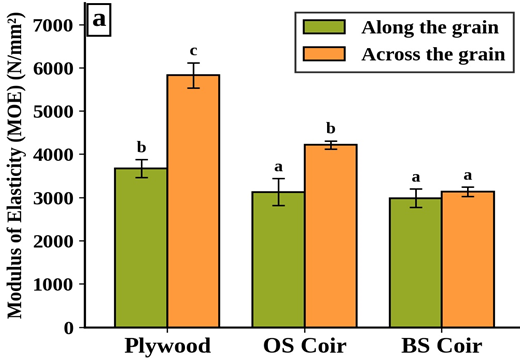
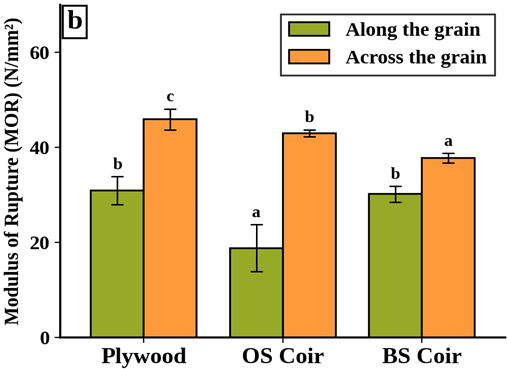
Fig. 4. Flexural performance of plywood and coir-based plywood composites. (a) Modulus of Elasticity (MOE) and (b) Modulus of Rupture (MOR) of conventional plywood, OS coir plywood, and BS coir plywood evaluated along and across the grain direction. Bars show mean values and error bars the standard deviation (n = 4). Different letters within the same grain direction indicate significant differences (Tukey's test, p < 0.05)
The MOE results are shown in Fig. 4(a). Because the coir–epoxy layers add thickness, MOE and MOR were calculated on the total panel thickness (Section 2.5.1). Along the grain, MOE decreased from 3670 N/mm² (control) to 3130 N/mm² for OS (−15%; p = 0.032) and 2990 N/mm² for BS (−19%; p = 0.009), with no difference between OS and BS (p = 0.696). Across the grain the decrease was larger: from 5830 N/mm² to 4220 N/mm² for OS (−28%) and 3140 N/mm² for BS (−46%) (p < 0.001 for both comparisons with the control). A mechanism based on reinforcement of the outer fibers and an increased second moment of area would predict higher stiffness in both grain directions, and is therefore not supported by these results. The consistent finding is a reduction in anisotropy: the across/along MOE ratio decreased from 1.59 for the control to 1.35 for OS and 1.05 for BS, so that the BS panel was nearly isotropic in bending stiffness. A plausible explanation is that the randomly oriented coir–epoxy layer has a lower and direction-independent in-plane modulus than the plywood veneers, so that adding it lowers the effective modulus of the section, and lowers it more in the stiffer across-grain direction. The in-plane modulus of the coir–epoxy layer was not measured, so this remains a plausible interpretation rather than a demonstrated mechanism. Any effect of alkali treatment on interfacial adhesion has been reported for coir-reinforced composites [7–11] but cannot be separated from the effect of the laminate itself because no untreated-coir panels were tested.
MOR is shown in Fig. 4(b). Along the grain, the BS panel retained the strength of the control (30.1 vs 30.9 N/mm², −2%; p = 0.948), whereas the OS panel decreased to 18.8 N/mm² (−39%; p = 0.002). The OS group showed the largest scatter (SD = 5 N/mm²), so this reduction should be interpreted with some caution. Across the grain, MOR decreased from 45.9 N/mm² to 43.0 N/mm² for OS (−6%; p = 0.048) and 37.7 N/mm² for BS (−18%; p < 0.001). The across/along MOR ratio therefore decreased from 1.48 for the control to 1.25 for BS, but increased to 2.29 for OS because of the along-grain reduction. The OS behavior is consistent with its asymmetric lay-up: reinforcing one face only shifts the neutral axis and produces an unbalanced section that can promote local bending and earlier failure, as reported for asymmetrically reinforced timber and wood laminates [23–25].
Overall, coir lamination did not raise the flexural modulus or strength of the plywood on a section basis. BS lamination preserved the along-grain strength and gave the most direction-balanced response, but at the cost of lower stiffness in both directions and lower strength across the grain; OS lamination reduced the along-grain strength most. The BS configuration may therefore suit applications where similar properties in both directions matter more than maximum stiffness.
3.2 Tensile performance
The mean tensile strengths of the three groups of specimens are given in Fig.5. Along the grain, tensile strength decreased significantly in the BS panel but not in the OS panel, whereas across the grain it decreased in both laminated panels, most strongly in the OS panel.
The control plywood had the highest tensile strength in both grain directions (20.7 N/mm² along and 25.1 N/mm² across the grain). Tensile strength of the laminated specimens was calculated on the total specimen cross-section (Section 2.5.2). Along the grain, the OS panel (18.1 N/mm², −13%) did not differ significantly from the control (p = 0.123), whereas the BS panel (16.5 N/mm², −20%) was significantly lower (p = 0.015); OS and BS did not differ from each other (p = 0.402). This pattern is reflected by the statistical letters in Figure 5: along the grain, control plywood is labelled “b”, OS plywood “ab”, and BS plywood “a”. The shared letters indicate that OS plywood did not differ significantly from either control or BS plywood, whereas control and BS plywood differed significantly from each other. Across the grain, tensile strength decreased in both laminated panels: by 45% for OS (13.7 N/mm²; p < 0.001) and by 22% for BS (19.5 N/mm²; p < 0.001), and the OS panel was also significantly lower than BS (p < 0.001), making it the most affected configuration. In tension, the stresses are distributed more evenly over the cross-section than in bending, where the outer layers carry the greatest stresses, so the contribution of the thin coir laminate is less apparent and the response remains controlled by the veneers and their grain direction. The marked across-grain loss of the OS panel is attributed to the asymmetric stiffness of the single-sided lay-up, which may produce secondary bending and non-uniform stress distribution under tensile loading, as reported for asymmetrically reinforced wood [23]; this mechanism was not verified here.
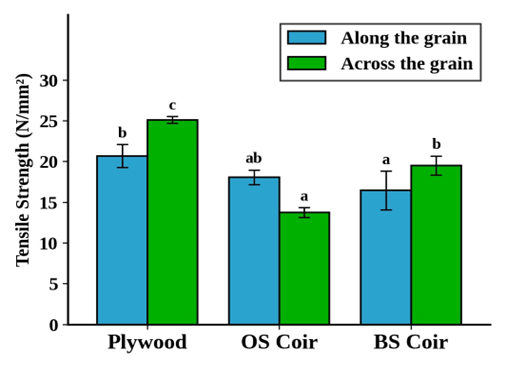
Fig.5. Comparison of the tensile strength of plywood, OS coir plywood, and BS coir plywood measured along and across the grain direction. Bars show mean values and error bars show the standard deviation (n = 4). Different letters within the same grain direction indicate significant differences (Tukey's test, p < 0.05)
Coir lamination did not increase tensile strength in any configuration. BS lamination reduced tensile strength moderately in both directions, whereas OS lamination caused a much larger across-grain loss, which argues against one-sided lamination where tensile loading is expected.
3.3 Water absorption behavior
The water absorption values obtained after 2 h and 24 h of immersion are summarized in Fig.6. Both laminated panels absorbed less water than the control (11.3% at 2 h and 30.9% at 24 h). At 2 h, absorption was 7.4% for OS (−35%) and 6.5% for BS (−42%); at 24 h, it was 19.8% for OS (−36%) and 17.7% for BS (−43%). These values are from a single specimen per configuration, so no statistical comparison was made.
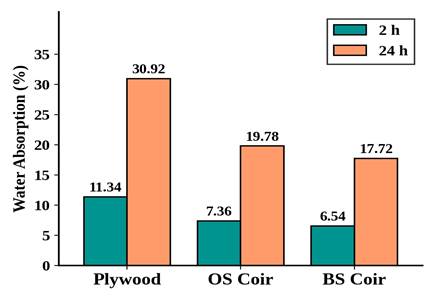
Fig. 6. Comparison of the water absorption behavior of plywood, OS coir plywood, and BS coir plywood after 2 h and 24 h of immersion (single specimen per configuration; values shown above the bars)
The reduction in water absorption is attributed mainly to the continuous cured epoxy film, which forms a hydrophobic barrier over the panel faces and limits water penetration into the veneers. Most of the reduction was already obtained with a single laminated face (35% and 36% for OS at 2 h and 24 h, against 42% and 43% for BS). The BS panel absorbed slightly less than the OS panel (0.8 and 2.1 percentage points lower at 2 h and 24 h), but with one specimen per configuration, this difference cannot be separated from specimen-to-specimen variability. The number of laminated faces therefore did not clearly control moisture uptake, whereas the continuity of the epoxy film appeared to. Alkali treatment (fewer interfacial voids that could promote moisture diffusion) and the relatively high lignin content of coir [4,26,27] may contribute as secondary effects, but these are plausible rather than demonstrated mechanisms, since no fiber-level or interfacial characterization was performed. Because the specimens were cut from larger panels and their edges were left unsealed, edge uptake (about one third of the exposed area of a 150 mm × 50 mm × 18 mm specimen) may also have contributed substantially, which may help explain why the one-face and two-face panels behaved similarly. These results are of interest for applications such as furniture, partitions, and wall panelling where moisture exposure is expected, although long-term durability was not evaluated.
3.4 Overall performance assessment
From the results obtained, coir lamination with epoxy modified the behavior of plywood in a direction-dependent way. It lowered the effective flexural modulus in both directions, reduced the anisotropy of the panel (most in the BS configuration), lowered tensile strength, and reduced water absorption. BS lamination retained the along-grain flexural strength, whereas OS lamination reduced along-grain MOR and, most strongly, across-grain tensile strength.
Coconut coir is an abundant agricultural by-product, and its use as a surface reinforcement valorizes a waste stream. However, the bisphenol-A epoxy matrix is a petrochemical thermoset that is neither bio-based nor recyclable, so the panels are only partly bio-based and the environmental benefit should not be overstated. A life-cycle assessment would be needed to establish any net advantage.
Practical relevance. The results indicate where coir-laminated plywood could and could not be used. The BS configuration gave the most direction-balanced bending response (across/along MOE ratio of 1.05, against 1.59 for plain plywood), retained the along-grain bending strength, and absorbed about 42–43% less water in the immersion test, but it lowered stiffness and tensile strength. The panels therefore appear better suited to non-structural interior applications such as furniture, partitions, wall and ceiling panelling, and fittings exposed to moisture, than to uses that depend on high stiffness or tensile capacity. The OS configuration should be avoided where across-grain tension is expected, because of its 45% tensile loss, and its along-grain bending strength was also reduced (−39%). The present results do not qualify the material for structural design: bond durability under wetting and drying cycles, creep, fire performance, fastener holding, and the long-term resistance of the coir–epoxy layer were not evaluated, and water absorption was measured on a single specimen per configuration. Testing against the requirements of the relevant plywood product standards, together with these durability aspects, is the necessary next step
4 Conclusions
In this study, the mechanical and moisture characteristics of commercially available 18 mm plywood strengthened with alkali-treated coconut coir fiber mat were examined. A bisphenol-A epoxy resin was used to obtain two types of reinforcement, such as one-side lamination (OS) and both-side lamination (BS), and tested using applicable Bureau of Indian Standards.
The results showed that lamination changed the performance of the plywood in a direction-dependent way. Calculated on the total panel thickness, MOE decreased in both laminated panels, by 19% along and 46% across the grain for BS, reducing the across/along MOE ratio from 1.59 to 1.05. The flexural response is therefore best explained by reduced anisotropy from the random-mat coir layer rather than by section stiffening. The BS panel retained its along-grain MOR but lost 18% across the grain, and the OS configuration reduced along-grain MOR by about 39%.
Coir lamination did not increase tensile strength. The BS laminate decreased by about 20% along and 22% across the grain, and the OS laminate, which was the most affected configuration, by about 45% across the grain.
Both laminated configurations reduced water absorption (about 35% for OS and 42% for BS at 2 h; about 36% for OS and 43% for BS at 24 h). The small difference between OS and BS suggests that the continuous cured epoxy film, rather than the number of laminated faces, is the main factor. Contributions from alkali treatment and coir lignin content are plausible secondary effects that were not verified.
Overall, alkali-treated coir mat laminated with epoxy can modify the directional flexural behavior and moisture uptake of plywood, with BS lamination giving the more balanced response, but it did not increase flexural modulus or strength on a section basis. The reinforcement is an agricultural by-product, but the bisphenol-A epoxy matrix is petrochemical-based and not recyclable, so the environmental benefit is partial. Limitations include the small number of replicates, the single water absorption specimen per configuration, the absence of an untreated-coir group, fiber-level or interfacial characterization, and cure-state assessment; these are suggested for future work.
Acknowledgements
The authors thank AK APPLE PLY PVT.LTD, Mangaluru, India, for providing the materials and characterization facilities to carry out this work.
References
- Joshi, S. V., Drzal, L. T., Mohanty, A. K., & Arora, S. (2004). Are natural fiber composites environmentally superior to glass fiber reinforced composites? Composites Part A: Applied Science and Manufacturing, 35, 371–376. https://doi.org/10.1016/j.compositesa.2003.09.016
- Wambua, P., Ivens, J., & Verpoest, I. (2003). Natural fibres: Can they replace glass in fibre reinforced plastics? Composites Science and Technology, 63, 1259–1264. https://doi.org/10.1016/S0266-3538(03)00096-4
- Ochi, S. (2008). Mechanical properties of kenaf fibers and kenaf/PLA composites. Mechanics of Materials, 40, 446–452. https://doi.org/10.1016/j.mechmat.2007.10.006
- Monteiro, S. N., Terrones, L. A. H., & D’Almeida, J. R. M. (2008). Mechanical performance of coir fiber/polyester composites. Polymer Testing, 27, 591–595. https://doi.org/10.1016/j.polymertesting.2008.03.003
- Tomczak, F., Sydenstricker, T. H. D., & Satyanarayana, K. G. (2007). Studies on lignocellulosic fibers of Brazil. Part II: Morphology and properties of Brazilian coconut fibers. Composites Part A: Applied Science and Manufacturing, 38, 1710–1721. https://doi.org/10.1016/j.compositesa.2007.02.004
- Rahman, M. M., & Khan, M. A. (2007). Surface treatment of coir (Cocos nucifera) fibers and its influence on the fibers’ physico-mechanical properties. Composites Science and Technology, 67, 2369–2376. https://doi.org/10.1016/j.compscitech.2007.01.009
- Rout, J., Misra, M., Tripathy, S. S., Nayak, S. K., & Mohanty, A. K. (2001). The influence of fibre treatment on the performance of coir-polyester composites. Composites Science and Technology, 61, 1303–1310. https://doi.org/10.1016/S0266-3538(01)00021-5
- Nam, T. H., Ogihara, S., Tung, N. H., & Kobayashi, S. (2011). Effect of alkali treatment on interfacial and mechanical properties of coir fiber reinforced poly(butylene succinate) biodegradable composites. Composites Part B: Engineering, 42, 1648–1656. https://doi.org/10.1016/j.compositesb.2011.04.001
- Shrivastava, R., & Parashar, V. (2022). Effect of alkali treatment on tensile strength of epoxy composite reinforced with coir fiber. Polymer Bulletin, 80, 541–553. https://doi.org/10.1007/s00289-021-04059-0
- Madueke, C. I., Ekechukwu, O. M., & Kolawole, F. O. (2024). A review on coir fibre, coir fibre reinforced polymer composites and their current applications. Journal of Renewable Materials, 12, 2017–2047. https://doi.org/10.32604/jrm.2024.055207
- Tai, C. K., Ahmad, R., Akil, H. M., & Ratnam, M. M. (2015). Effect of alkali treatment and molding temperature on flexural and impact properties of coir-fibre-epoxy composite. Advanced Composites Letters, 24, 73–80. https://doi.org/10.1177/096369351502400403
- Fiore, V., Di Bella, G., & Valenza, A. (2015). The effect of alkaline treatment on mechanical properties of kenaf fibers and their epoxy composites. Composites Part B: Engineering, 68, 14–21. https://doi.org/10.1016/j.compositesb.2014.08.025
- Mishra, S., & Parashar, V. (2025). Reducing the heterogeneity in tensile strength in the coir (Cocos nucifera)-epoxy composite through enhancing surface quality and maintaining longitudinal integrity. Arabian Journal for Science and Engineering, 50, 8975–8993. https://doi.org/10.1007/s13369-024-09331-9
- Venkatesh, R. (2024). Alkali process coir natural fiber incorporated epoxy composite made by compression mold route: Characteristics evaluation. Journal of The Institution of Engineers (India): Series D, 1–5. https://doi.org/10.1007/s40033-024-00723-7
- Puttaswamygowda, P. H., Sharma, S., Ullal, A. K., & Shettar, M. (2024). Synergistic enhancement of the mechanical properties of epoxy-based coir fiber composites through alkaline treatment and nanoclay reinforcement. Journal of Composites Science, 8(2), Article 66. https://doi.org/10.3390/jcs8020066
- Moezzipour, B., Ahmadi, M., & Moezzipour, A. (2017). Physical and mechanical properties of reinforced plywood with natural fibers. Journal of the Indian Academy of Wood Science, 14, 70–73. https://doi.org/10.1007/s13196-017-0189-7
- Jorda, J., Kain, G., Barbu, M. C., Köll, B., Petutschnigg, A., & Král, P. (2022). Mechanical properties of cellulose and flax fiber unidirectional reinforced plywood. Polymers, 14, Article 843. https://doi.org/10.3390/polym14040843
- Bal, B. C. (2014). Flexural properties, bonding performance and splitting strength of LVL reinforced with woven glass fiber. Construction and Building Materials, 51, 9–14. https://doi.org/10.1016/j.conbuildmat.2013.10.041
- Saal, K., Kallakas, H., Tuhkanen, E., Just, A., Rohumaa, A., Kers, J., Kalamees, T., & Lohmus, R. (2024). Fiber-reinforced plywood: Increased performance with less raw material. Materials, 17, Article 3218. https://doi.org/10.3390/ma17133218
- Cordier, M., & Mai, C. (2025). Basalt grid reinforcement of lightweight plywood. European Journal of Wood and Wood Products, 83, 45–?. https://doi.org/10.1007/s00107-024-02196-7
- Núñez-Decap, M., Barra-Rodríguez, Y., Opazo-Carlsson, C., Moya-Rojas, B., Vidal-Vega, M., & Opazo-Vega, A. (2022). Use of carbon and basalt fibers with adhesives to improve physical and mechanical properties of plywood. Applied Sciences, 12, Article 5114. https://doi.org/10.3390/app12105114
- Valencia, F. R., Castillo-López, G., Aurrekoetxea, J., & Lopez-Arraiza, A. (2022). Fibre-wood laminate biocomposites: Seawater immersion effects on flexural and low energy impact properties. Polymers, 14, Article 4038. https://doi.org/10.3390/polym14194038
- Guo, X., Zhou, F., Deng, S., & Dong, C. (2023). Study on the static-bending properties of surface-reinforced wood with asymmetric fibers. Forests, 14, Article 2454. https://doi.org/10.3390/f14122454
- Borri, A., Corradi, M., & Grazini, A. (2005). A method for flexural reinforcement of old wood beams with CFRP materials. Composites Part B: Engineering, 36, 143–153. https://doi.org/10.1016/j.compositesb.2004.04.013
- Corradi, M., & Borri, A. (2007). Fir and chestnut timber beams reinforced with GFRP pultruded elements. Composites Part B: Engineering, 38, 172–181. https://doi.org/10.1016/j.compositesb.2006.07.003
- Kirubakaran, R., Pitchumani, S. V., Tom, S., Nagaraj, R. A., Salin, P., Natchimuthu, H. K., Gopalan, V., & Vinayagamurthy, G. (2025). Investigation of corrosion and water absorption of biomass natural coir fiber/HBN reinforced epoxy hybrid composites using different optimisation approaches. Scientific Reports, 15, Article 3388. https://doi.org/10.1038/s41598-025-87673-6
- Dhakal, H. N., Zhang, Z. Y., & Richardson, M. O. W. (2007). Effect of water absorption on the mechanical properties of hemp fibre reinforced unsaturated polyester composites. Composites Science and Technology, 67, 1674–1683. https://doi.org/10.1016/j.compscitech.2006.06.019
Conflict of Interest Statement
The authors declare that they have no conflict of interest in the publication of this article.
Author Contributions
Data Availability Statement
There is no dataset associated with the study.
Supplementary Materials
There are no supplementary materials to include.