Volume 24 article 1332 pages: 277-298
Received: Nov 21, 2025 Accepted: Mar 20, 2026 Available Online: Apr 30, 2026 Published: May 31, 2026
DOI: 10.5937/jaes0-62931
METHODS AND TECHNIQUES FOR ESTIMATING CONCEPTUAL COSTS IN PUBLIC HIGHWAY PROJECTS: A SYSTEMATIC LITERATURE REVIEW
Abstract
Accurate cost estimation during the conceptual phase of public highway construction is essential for effective transportation planning and budgeting. This paper reviews techniques and methods for initial cost estimation in highway projects, focusing on accuracy, trends, and key cost drivers. The research methodology involved selecting relevant papers by reviewing titles, abstracts, keywords, and full texts during the final stage. This process yielded 87 relevant publications and 33 cost estimation methods and techniques spanning the period from 1980 to 2025. The study found that artificial neural networks, machine learning, and regression analysis are the most used methods for predicting costs early in projects, with machine learning techniques showing the highest accuracy. Among the 184 cost drivers reviewed, 50 were grouped into five categories, providing a basis for selecting critical inputs during the planning phase of cost estimation for highway projects. A thorough review of the research literature highlights gaps and provides recommendations for future studies to focus on the use of advanced technologies to improve cost estimation. Specifically, employing GIS and 3D terrain models, along with geomechanical data, can help accurately calculate the quantities of all items in the bill of quantities. Such advancements are expected to enhance the precision of conceptual cost estimation in highway construction.
Highlights
- This study presents a variety of cost-estimation methodologies that leverage advanced algorithms to enhance the accuracy and reliability of project budgets during the planning/conceptual phase.
- A complementary error metric has been introduced to quantitatively assess the accuracy of cost estimates, thereby enhancing decision-making. The commonly used mean absolute percentage error (MAPE) was expanded with 13 additional error metrics.
- Identifying key cost drivers offers valuable insights into the factors affecting project costs and suggests strategies for effective cost management.
- The trend of the reviewed literature, methods, and techniques leads to new machine learning and artificial intelligence algorithms as powerful tools for cost estimating in different phases of project development.
Keywords
Content
1 Introduction
The state highway enterprise's ability to effectively manage long-term capital investments heavily depends on the accuracy of construction cost estimates. Conceptual cost estimation is a fundamental tool for planning road infrastructure, enabling early financial evaluations even with limited design details and scope uncertainties [1]. These initial estimates help project managers identify major cost drivers and create strategies to stay within budget once the project scope is finalized [2]. Early estimates also serve as benchmarks for monitoring project progress and measuring performance. Industry standards categorize cost estimates into five classes based on the level of project scope development [3]. During the early phase, Class 5 estimates are used to evaluate conceptual feasibility, with scope definitions ranging from 0% to 2%. Accuracy expectations for this class vary from –25% to +75%, reflecting high uncertainty in early planning stages [4]. Accurate early-stage estimates are crucial for effective budget planning, easing the approval of essential programs, and minimizing the need for additional funding [5]. Nonetheless, empirical studies indicate that public highway projects frequently encounter cost overruns, averaging 20.4% across 167 projects. This research illustrates the importance of enhanced risk management in the early phases of project planning and forecasting [6].
Identifying risks and estimating costs during the scope definition stage is difficult mainly because of limited data on design complexity and site constraints. These limitations can lead to inaccurate forecasts and an increased risk of cost overruns in public highway projects. Past studies examined various factors that affect the accuracy of early estimates, such as complexity, project size, and unreliable data [7-9]. Additionally, the choice of estimation methods greatly influences results, with research linking thorough methodologies to patterns of cost overruns [10]. Scientific literature emphasizes the importance of conceptual forecasting, which considers variables that impact feasibility, contingency planning, and cost-risk assessment [11, 12]. Furthermore, the availability and quality of data are crucial for estimation methods during the early design phase, as they affect forecast reliability and risk management in budgeting. Recent research has focused on improving performance metrics to enhance predictive accuracy in highway cost modeling [14, 15], especially by incorporating advanced data analytics and machine learning techniques to better account for variables that influence cost estimates.
Conceptual estimation supports stakeholder decision-making by guiding budget allocation and risk management strategies. It also provides the transparency and foresight needed to align public expectations and minimize discrepancies in project schedules and costs [16]. To address these challenges, this study conducts a systematic literature review focused on the following research questions:
- RQ1: What cost estimation techniques and methods are commonly applied during the early stages of highway project development, and what trends characterize the reviewed literature?
- RQ2: Which cost estimation approaches exhibit the highest accuracy under conceptual constraints?
- RQ3: What cost drivers (CDs) have the most substantial impact on early-stage highway construction costs?
The review focuses on identifying effective techniques for the conceptual estimation phase, which is characterized by limited data availability. It includes a comparative error analysis to rank model accuracy and a systematic evaluation of the frequency and type of cost drivers to clarify their impact on estimation results.
2 Materials and methods
2.1 Literature search and inclusion criteria
A systematic literature review was performed to address the research questions, examining publications from 1980 to 2024, synthesizing prior work, summarizing methodological advancements, and identifying areas for further inquiry. The examined sources comprise Scopus, Web of Science, ScienceDirect, Google Scholar, the American Society of Civil Engineers, and the Transportation Research Board. Initial research was performed using the TITLE-ABS-KEY fields, focusing on highway infrastructure and conceptual estimation. Search terms included “cost estimate,” “cost prediction,” “conceptual estimate,” “cost assessment,” and “highway cost estimation.”
2.2 Screening and selection process
The literature selection was conducted in four sequential stages:
- Duplicate removal: All duplicate entries have been eliminated from the database results.
- Title and abstract screening: Irrelevant publications were excluded after reviewing titles, abstracts, and keywords.
- Full-Text evaluation: Documents were excluded if, after a full review, they did not meet the inclusion criteria for highway-focused conceptual cost modeling.
- Peer-reviewed studies that include clear methodological descriptions.
2.3 Data extraction and classification
Quantitative data were used to classify studies by publication year, model type, and geographic origin. Techniques identified in selected papers included historical, machine learning, artificial intelligence, hybrid, and soft computing methods. Cost driver variables were cataloged to assess frequency, composition, and relevance.
2.4 Accuracy evaluation and cost driver analysis
Descriptive statistics compared the predictive accuracy of models using error metrics, including scale-sensitive, percentage-based, and classification-aware measures. An expert review also identified key cost drivers for reliable forecasting.
2.5 Final search and methodological framework
The database search ended on February 27, 2026. Figure 1 shows the complete workflow for data search, filtering, extraction, and synthesis.
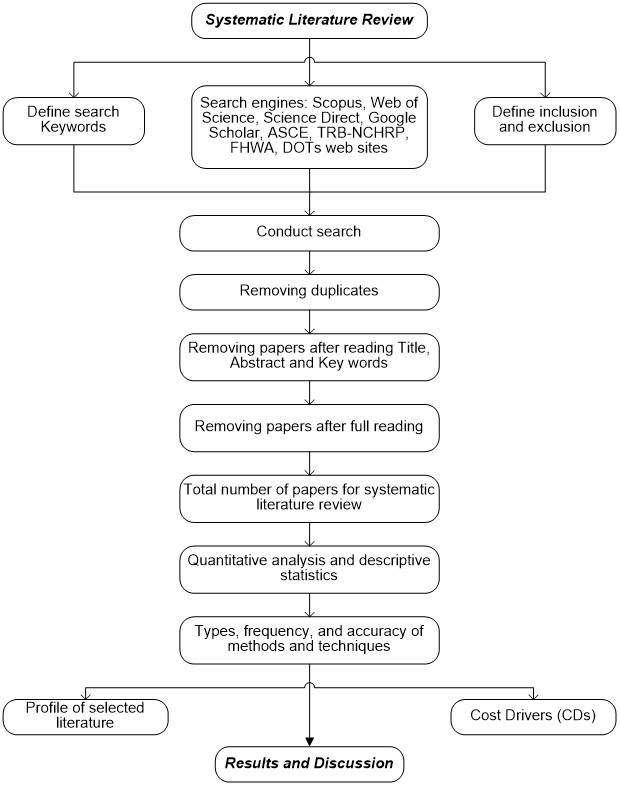
Fig. 1. Research methodology process
3 Results and discussion
The initial search yielded 392 records. After eliminating 104 duplicates and screening titles, abstracts, and keywords, 201 publications were excluded. A full-text review led to the removal of four additional papers. The final dataset includes 77 peer-reviewed papers, five dissertations, and five books, totaling 87 publications selected for the systematic literature review.
3.1 Evaluating performance
A total of 14 error metrics were identified across the reviewed literature, reflecting their widespread use in assessing the accuracy of regression and classification models. These metrics include:
- Relative error metrics: Mean Absolute Percentage Error (MAPE), Mean Percentage Error (MPE), Absolute Percentage Error (APE), Mean Relative Error (MRE), Mean Magnitude Relative Error (MMRE), Mean Absolute Error Relative (MAER), Mean Absolute Error Relative (MAEE)
- Hybrid error metrics (incorporate magnitude-based deviation with scalable or normalized attributes):
Mean Squared Error (MSE), Root Mean Squared Error (RMSE), Mean Absolute Error (MAE), Root Mean Absolute Error (RMAE), Normalized Root Mean Square Error (NRMSE), Absolute Error (AE) - Other evaluative metric for goodness-of-fit or classification performance is the Coefficient of Determination (R-squared, R²).
This review prioritizes relative error metrics for their suitability for comparative analysis across diverse methods, while hybrid methods were used when results were expressed as relative numbers. Accuracy is further contextualized by considering the sample size and the number of CDs integrated into each cost estimation technique.
3.2 Review of estimation methods and techniques (RQ1)
This section outlines methods and techniques categorized into distinct groups or utilized independently. A review of the selected literature identified three main groups: regression analysis, machine learning and artificial intelligence, and risk-based approaches. Expert opinion remains the most crucial method employed in every predictive approach, while building information modeling represents the newest method, still in the development phase for application in cost estimation.
Given the limited data available for early cost prediction and analysis of research findings, expert opinions are crucial during the initial cost estimation stage. In contrast, an engineering approach for estimating road construction costs utilizes engineering formulas to develop cost estimates [18]. It also involves initial techniques for estimating road costs, including per-unit, work-item, and required-quantity estimates. Experts refine cost estimation by integrating sub-models for various work categories during the preliminary stage, which helps to improve accuracy and account for specific project requirements and conditions. Furthermore, expert insights are crucial for developing AI applications that estimate costs for complex projects [19].
The choice of estimation software was essential to the evolution of cost estimation, and Microsoft Excel remains a widely adopted platform for cost calculation and database management due to its simplicity and adaptability [20]. Enhanced spreadsheet techniques have been shown to reduce deviation between conceptual and final costs, reporting an average difference of 22% [21]. Interactive applications built with Microsoft Access and Visual Basic further improved item-level estimation during early project phases [22]. In pursuit of open-access solutions, web-based systems built with PHP, Apache, and MySQL have been deployed to reduce development costs and improve accessibility [23]. Additionally, optimization algorithms, such as linear programming implemented in LINGO 13.0, have increased predictive accuracy in highway cost modeling [24].
3.2.1 Regression analysis
Multiple regression analysis has facilitated cost modeling across various project types and has been effective for estimating highway construction parameters [25, 26]. Generalized Linear Models (GLMs) have improved planning in roadworks and traffic management [27]. Linear regression models generally match empirical construction data well, especially for bid amounts and physical project features [28, 29]. Additionally, these models have been used to estimate initial costs in highway construction, showing strong correlations between variables with predicted costs [30]. This approach has been expanded by developing eleven regression models to predict total costs of road projects, considering bid values, road length, and width [31]. To avoid budget overruns, models have been developed to predict total costs early in road construction projects. These models employ the Ordinary Least Squares (OLS) method within a linear regression framework to assess key decision variables [32].
The OLS model incorporates geotechnical variables to prevent budget overruns [33]. LASSO regression has enhanced parameter selection and model robustness by reducing noise in cost driver variables [34]. A hybrid approach combining Grey Relational Analysis (GRA) and LASSO provides a valid method for predictive performance [35]. Recent applications of multiple regression analysis (MRA) highlight the importance of precise preconstruction forecasting in variable-rich environments [36].
3.2.2 Machine learning algorithms
Artificial Neural Networks (ANNs) are a machine learning approach that examines large datasets to produce accurate cost predictions. A key study showed the effectiveness of regularized artificial neural networks (RNNs) for highway construction estimation [37]. Combining ANN software with historical cost databases improves prediction accuracy. Comparative studies indicate that ANNs outperform MRA in early cost prediction stages [38], mainly when diverse datasets are used [39]. Further refinements in artificial neural network (ANN) techniques involve applying multilayer perceptron (MLP) architectures. These architectures are used to classify highway cost models by regional, national, and project-based criteria, aiming to optimize inputs for regional forecasting [40].
This analysis also included MLP and RA in a pre-feasibility study to estimate costs effectively [41]. Time-dependent cost increases, such as those monitored by the highway construction cost index, were modeled using an MLP with inputs that include materials, labor, equipment, and contract variables [42]. MLP models achieved higher accuracy than regression models with the same input variables, particularly in early-stage estimates [43].
Integrating ANNs with bootstrap sampling significantly advanced cost and risk estimation. This method applied historical data to mitigate optimism and bias in preliminary cost estimates, resulting in more reliable predictions for construction projects [44]. NEUFRAME software version 4 was used to develop MLPs and to develop formulas for early cost estimation in highway projects [45,46]. Some studies improved estimation techniques for highway construction using ANNs, developing three network configurations based on the MLP architecture [47, 48]. Evaluating different neural networks—MLP, GRNN, and RBFNN—highlights the need to compare model performance and enhance the accuracy of cost prediction [49].
Deep learning algorithms, particularly Deep Neural Networks (DNNs) implemented in TensorFlow and Keras using Python 3.7, significantly influence the assessment of factors affecting cost estimation in infrastructure projects [50]. Combining ANN with MRA produces more accurate cost estimates and improves early prediction methods [51]. Ridge regression with a generalized feedforward neural network (GFNN) results in better cost-estimation models for resurfacing, outperforming MLPs [52]. A study compared LASSO, MARS, and GRNN using the same datasets to develop and assess their modeling performance [53]. Models predicting road construction costs, including one for state highway agencies in the USA, use techniques such as LASSO and GRNN to forecast costs [54,55]. Additionally, comparing Convolutional Neural Networks (CNNs), ANNs, and RA models highlight advancements in early cost management [56]. A review of cost estimation techniques for infrastructure projects reveals that parametric approaches, particularly regression analysis, are the most utilized methods, followed by ANN and unit cost estimation [13].
Case-based reasoning (CBR), a powerful machine learning method that compares past experiences to solve new challenges, is commonly used in the early stages of cost estimation models to identify suitable analogous inputs [57]. An innovative estimation framework utilizing MLP was developed for early cost estimation in highway projects, showing high accuracy through the combination of CBR and expert opinion [17]. A hybrid model combining the Analytic Hierarchy Process (AHP) with CBR has been proposed to improve preliminary cost estimates for highway projects, refining weights within the CBR framework [58]. Additionally, a new method that combines rough set theory with CBR and a genetic algorithm (GA) has been shown to increase forecasting accuracy for road construction costs [59,60]. CBR is also used to estimate unit prices for construction work items, highlighting its practical significance in infrastructure cost estimation [61].
Evolutionary algorithms (EAs) provide an alternative to ANNs for unsupervised machine learning, allowing performance assessment through fitness functions. Major types include evolutionary programming, genetic algorithms (GAs), and genetic programming. Some research uses these algorithms to predict construction costs. Many studies also focus on hybrid frameworks for road projects, combining methods such as backpropagation and simplex optimization to reduce cost estimation errors [62]. Additionally, a new forecasting model based on gene expression programming was developed to improve predictions of highway construction costs and overcome the limitations of current methods [63].
Decision trees (DTs) are a significant method for estimating preliminary costs for highway projects, particularly within a top-down approach [64]. Furthermore, the decision tree method has proven to be a practical approach for developing a cost-predicting model grounded in machine learning principles, as it allows for the analysis of various factors influencing costs and can improve accuracy in predictions compared to traditional methods [65].
A support vector machine (SVM) is a versatile supervised machine learning algorithm used for classification and regression. It improves the precision of parametric cost estimates for road projects during their early stages [66]. A study showed that SVM outperformed ANNs in predictive accuracy [67]. Additionally, DTREG software was employed to create hybrid models, with the SVM-Bromilow TCM model reaching the highest accuracy [68].
Ensemble learning methods (EL) combine multiple machine learning algorithms to produce weak predictive results from different data projections. These weak predictions are combined to create a more robust, more accurate prediction. This method reduces bias and variance in predictive models, improving overall performance. Techniques like bagging, boosting, voting, stacking, and random forest enhance the predictive power of the ensemble model. The results are fused with voting mechanisms to achieve better results than any individual algorithm alone. An analytical study focused on the reliability of construction cost estimation models utilizing ANNs (SVMs) and Random Forest (RF) algorithms has revealed the effectiveness of a merged model that incorporates voting and stacking EL methods. This approach has significantly enhanced the accuracy of cost estimations. Integrating the Monte Carlo simulation technique further reinforced the validation of the findings [69].
XGBoost, or eXtreme Gradient Boosting, a supervised machine learning algorithm, effectively implements gradient boosting. In ensemble learning for classification and regression, XGBoost combines the predictions of multiple weak models to yield enhanced predictions. Recent research focused on predicting changes in highway construction costs successfully used machine learning methods, like gradient boosting, extreme gradient boosting, and random forest with ANNs, to make more accurate predictions. Benchmark methods, such as Monte Carlo simulation and MRA, were employed to compare the models' effectiveness. The findings indicated that all machine learning models outperformed traditional multiple regression methods. This underscores the efficacy of the ensemble learning approach in generating more precise cost predictions compared to existing methodologies [70]. MRA, ANN (MLPRegressor), and XGBoost also developed models that accurately forecast highway construction costs from contractors' and owners' perspectives [71].
A study aimed at assessing the accuracy of SVMs and ANNs in predicting the costs associated with highway construction utilized the RF algorithm, which combines the results of multiple decision trees into a single outcome. This research employed Python programming with the Scikit Learn library package. Random Forest proved higher predictive accuracy than ANNs and SVMs [72]. The comparison among the stacking ensemble, RA, SVM, and MLP indicated that the stacking ensemble achieved the highest level of accuracy [73].
Various machine learning algorithms were employed to predict cost items, including DT, RF, K-nearest neighbors, and neural networks. The researchers also assessed multiple linear regression models, which included linear regression, ridge regression, Bayesian ridge regression, stochastic gradient descent, and passive-aggressive regression [65]. A comparative analysis of the performance of four algorithms—ridge regression (RR), least absolute shrinkage and selection operator (LASSO), K-nearest neighbors (k-NN), and RF—in estimating conceptual costs indicated that ridge regression was the most accurate model based on the selected input variables [74].
Fuzzy logic (FL) AI makes decisions by simulating reasoning. When data is insufficient or misleading, fuzzy logic is often employed to aid decision-making because conceptual cost predictions are difficult to access. An innovative, web-based intelligent cost estimator (WICE) was developed to support the conceptual cost estimation stage. The system was based on the PIREM (Principal Items Ratio Estimation Technique), which combined the principal items technique and the parametric estimation approach. WICE combined neuro-fuzzy artificial intelligence with web-based information technology to provide real-time estimating, sensitivity analysis, minimal maintenance costs, global accessibility, and high estimation accuracy [75]. FL is often used to develop a model for optimizing input variables (CD) in cost prediction using the fuzzy-AHP approach [76]. The findings on methods for calculating cost contingency indicate a flexible and reasonable approach that aligns with contractors' preferences. This methodology relies on subjective judgment, principles of risk analysis, and fuzzy expert systems. Consequently, contractors can effectively utilize this method in various construction scenarios, making it a valuable tool for estimating unforeseen costs [77].
3.2.3 Risk-based approach
The risk-based approach, like the top-down method, uses techniques such as MC simulations, statistical models, and the PERT method for probabilistic analysis. MC cost estimation effectively assesses project costs by simulating scenarios and assigning random values to uncertain variables. This produces a range of potential cost overruns and probabilities, making it useful for risk management and contingency planning.
The PERT technique uses three key estimates for each activity: optimistic, pessimistic, and most likely. It helps estimators thoroughly consider possible outcomes and understand potential costs. The PERT method combines these three forecasts into a single estimate, making decision-making easier and improving project planning. By merging minimum, most likely, and maximum output values, it offers a realistic estimate that better reflects project uncertainties [78].
A risk-based cost contingency estimate model (RBCCEM) developed to address cost overruns demonstrates superior accuracy compared to traditional methods [79]. An analytics solution that performs risk analysis using Monte Carlo simulation in spreadsheets, Palisade@RISK, was beneficial for a probabilistic cost estimation model for highway projects [80]. Furthermore, researchers developed a rapid and precise approach to assess project risk based on historical data, including allowances and contingencies [81]. Furthermore, statistical models use historical data to estimate costs and predict item-level quantities based on project parameters. A prediction model employs relevant data for key work items. The Preliminary Item-Level Cost Estimating System helps create preliminary estimates. Separating unit prices from quantities enhances accuracy by tracking price inflation and adjusting to changes in project scope [82, 83]. Statistical analyses comparing predicted costs to actual costs show that underestimation happens in 90% of sample projects [84]. Additionally, models assess results using methods such as the common exponential function (CEF), linear regression (LR), exponential functions (EF), Cobb-Douglas exponential (CDE), and RA [85].
Integrating BIM and GIS enables reliable cost estimates for national highway construction, including construction, land acquisition, and maintenance. This approach improves flexibility and efficiency over traditional methods by using 3D visualization to reduce risk and help stakeholders spot obstacles and environmental impacts [86]. It discusses how labor, processes, and technology impact digital transformation, examines cost-estimation issues in infrastructure, and promotes ongoing training and BIM integration with process specifications [87].
The literature review identifies 33 methods and techniques related to artificial intelligence, machine learning, regression analysis, and risk-based approaches. Among these methods, statistics stand out as the most used tool in risk-based and historical methods. It is important to note that all the reviewed methods rely on a historical database. However, they vary in their approach to using this data and the accuracy of their predictions. Figure 2 displays 33 methods and techniques, along with their frequencies.
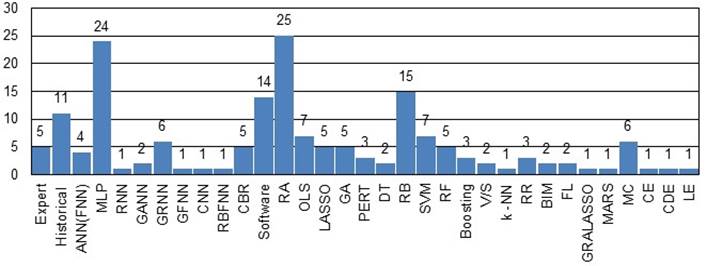
Fig. 2. Frequency of methods in selected literature
The trend of the listed methods and techniques, as shown in Figure 2, is depicted in Figure 3.
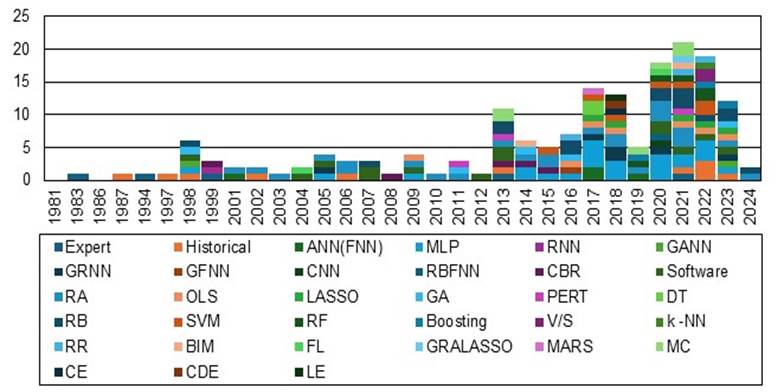
Fig. 3. Trend distribution of the methods and techniques from the selected literature
An examination of 87 studies revealed patterns in methods, publication frequency, and geographic distribution. Research literature, as shown in Fig. 4, has steadily increased over the past decade, mainly driven by advances in digital infrastructure and better data access. This trend has led to enhanced accuracy and flexibility in data analysis and cost estimation.
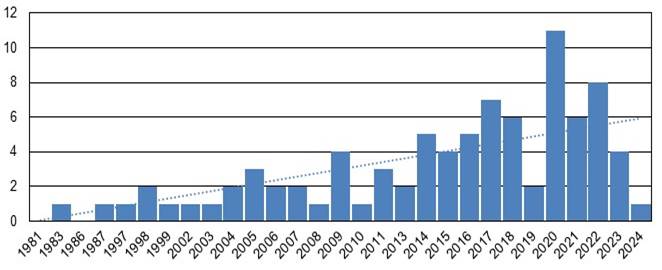
Fig. 4. Trend distribution of the reviewed literature
According to Fig. 5, the United States has produced the most studies, accounting for up to 55.17% of the total, followed by the United Kingdom at 14.94%, the Netherlands at 8.04%, and India at 5.74%. Australia and Switzerland each contributed 2.3%, while the remaining ten countries each made up 1.15%. This distribution highlights a global focus on infrastructure research.
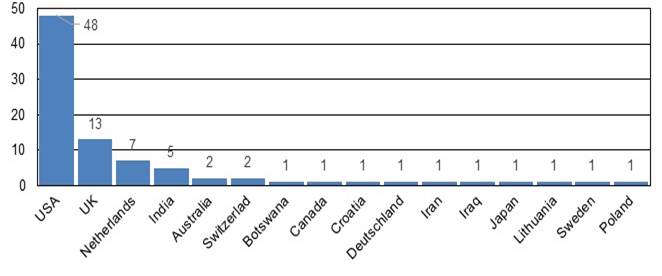
Fig. 5. Country-wise literature distribution
3.3 Accuracy of cost estimation methods (RQ2)
Cost estimation methods were assessed using descriptive statistics and tables summarizing error metrics. Techniques with at least four results per metric were included in the statistical analysis, while those with fewer than four were listed separately. Table 1 shows descriptive statistics for MAPE results across seven techniques: MLP, RA, SVM, GRNN, OLS, LASSO, and RF. Sample sizes varied significantly, ranging from 241 to 17,372 projects. MLP and GRNN exhibited the most considerable variation in prediction errors. In contrast, RF and SVM had the lowest average errors and variability, indicating they were the most reliable among the methods tested.
Table 1. Descriptive statistics of MAPE results
|
Descriptive Statistic |
MLP |
RA |
SVM |
GRNN |
OLS |
LASSO |
RF |
|
Number of Studies |
18.00 |
15.00 |
4.00 |
5.00 |
4.00 |
5.00 |
4.00 |
|
Number of Projects |
7,022.000 |
3,755.00 |
2,163.00 |
2,285.00 |
241.00 |
4,512.00 |
17,372.00 |
|
Minimum |
0.54 |
0.21 |
1.01 |
1.38 |
7.60 |
0.00 |
0.70 |
|
Maximum |
70.30 |
50.00 |
16.70 |
71.00 |
50.00 |
51.00 |
14.80 |
|
Range |
69.76 |
49.79 |
15.69 |
69.62 |
42.40 |
51.00 |
14.10 |
|
Mean |
19.920 |
17.470 |
7.440 |
35.668 |
18.380 |
23.020 |
7.792 |
|
Median |
19.100 |
16.320 |
6.030 |
22.900 |
7.965 |
7.010 |
7.835 |
|
Standard Deviation |
15.650 |
12.730 |
5.770 |
29.246 |
18.250 |
22.970 |
5.322 |
|
Q1 |
8.46 |
8.10 |
3.01 |
7.22 |
7.77 |
3.00 |
2.95 |
|
Q3 |
27.47 |
25.00 |
11.88 |
70.50 |
29.00 |
51.00 |
12.64 |
|
Number of Outliers |
1 |
0 |
0 |
0 |
0 |
0 |
0 |
|
Skewness |
1.560 |
0.787 |
0.666 |
0.245 |
1.154 |
0.373 |
-0.018 |
|
Kurtosis |
6.370 |
3.520 |
2.050 |
1.262 |
2.333 |
1.190 |
1.570 |
|
Coefficient of Variation |
0.785 |
0.730 |
0.775 |
0.820 |
0.990 |
0.997 |
0.683 |
Table 2 presents descriptive statistics for R2, a standard measure of predictive strength. MLP recorded the highest average and median values, followed by OLS and RA. Although all three methods showed acceptable ranges, RA displayed more variability in performance across studies.
Table 2. Descriptive statistics of R2 results
|
Descriptive Statistic |
MLP |
RA |
OLS |
|
Number of Studies |
6 |
14 |
4 |
|
Number of Projects |
3314 |
7425 |
3280 |
|
Minimum |
0.574 |
0.001 |
0.526 |
|
Maximum |
0.969 |
0.980 |
0.988 |
|
Range |
0.395 |
0.979 |
0.462 |
|
Mean |
0.823 |
0.675 |
0.686 |
|
Median |
0.874 |
0.775 |
0.616 |
|
Standard Deviation |
0.166 |
0.294 |
0.205 |
|
Q1 |
0.680 |
0.470 |
0.57 |
|
Q3 |
0.968 |
0.960 |
0.803 |
|
Number of Outliers |
0 |
0 |
0 |
|
Skewness |
-0.706 |
-0.922 |
1.732 |
|
Kurtosis |
4.911 |
4.229 |
16.792 |
|
Coefficient of Variation |
0.202 |
0.436 |
0.299 |
Methods with fewer than four results per metric were listed separately, as shown in Table 3.
Table 3. Methods and techniques with 1 to 3 results per error metric
|
R2 |
MAPE |
|||||
|
Historical |
0.68 |
CBR |
16.26 |
|||
|
Software |
0.80 |
0.62 |
GA |
16.26 |
||
|
RBFNN |
0.95 |
0.94 |
RB |
1.86 |
21.00 |
|
|
V/S |
0.98 |
RBFNN |
1.52 |
38.04 |
||
|
k NN |
0.99 |
CNN |
17.00 |
|||
|
RR |
1.00 |
FL |
4.44 |
|||
|
MARS |
0.64 |
GRALASSO |
5.00 |
|||
|
Common Exponential |
0.72 |
DT |
0.68 |
|||
|
Cobb-Douglas Exponential |
0.70 |
RR |
0.55 |
0.00 |
||
|
Linear Exponential |
0.67 |
V/S |
4.40 |
|||
|
RF |
0.99 |
k-NN |
0.60 |
|||
|
MSE |
Boosting |
22.00 |
7.64 |
|||
|
GA |
3.00 |
MARS |
40.00 |
|||
|
V/S |
0.05 |
MC |
9.82 |
|||
|
RA |
2.73 |
ANN(FNN) |
7.56 |
0.20 |
||
|
SVM |
3.09 |
RMSE |
||||
|
MLP |
9.10 |
0.05 |
RF |
0.96 |
||
|
RR |
0.00 |
V/S |
0.22 |
|||
|
LASSO |
0.00 |
RA |
1.65 |
|||
|
MAEE |
SVM |
1.26 |
1.76 |
|||
|
CBR |
8,76 |
5.70 |
MLP |
22.36 |
1.18 |
0.23 |
|
RB |
5.20 |
RR |
0.00 |
|||
|
APE |
LASSO |
0.06 |
||||
|
OLS |
3.06 |
11.00 |
MPE |
|||
|
Software |
10.45 |
GRNN |
40.00 |
|||
|
Expert |
8.10 |
LASSO |
30.00 |
|||
|
LASSO |
13.00 |
OLS |
10.00 |
|||
|
GRNN |
40.00 |
MMRE |
||||
|
MARS |
8.00 |
GRNN |
25.00 |
|||
|
NRMSE |
RA |
33.00 |
||||
|
GRNN |
22.8 |
MAER |
||||
|
LASSO |
10.00 |
10.32 |
MLP |
16.00 |
||
|
OLS |
12.00 |
10.47 |
GA |
16.00 |
||
|
GRA-LASSO |
8.00 |
AE |
||||
|
RE |
GANN |
19.33 |
||||
|
GA |
5.90 |
GA |
21.18 |
|||
|
MAE |
RNN |
17.76 |
||||
|
V/S |
0.11 |
Historical |
22.44 |
|||
|
RA |
1.46 |
Software |
22.00 |
|||
|
SVM |
1.34 |
CBR |
7.50 |
|||
|
MLP |
0.15 |
OLS |
0.63 |
|||
|
MRE |
PERT |
20.00 |
||||
|
MLP |
0.60 |
RB |
2.00 |
|||
Regarding tables 1 to 3, Table 4 provides a detailed summary of the most accurate techniques and their respective error rates, enabling easy comparison of accuracy across all evaluated methods and metrics.
Table 4. The most precise methods expressed through complementary error metrics
|
Method |
E. Metric |
Error (%) |
|
LASSO |
MAPE |
0.00 |
|
RR |
MAPE |
0.00 |
|
V/S |
MSE |
0.05 |
|
MLP |
MSE |
0.05 |
|
ANN(FNN) |
MAPE |
0.20 |
|
RA |
MAPE |
0.21 |
|
k -NN |
MAPE |
0.60 |
|
OLS |
AE |
0.63 |
|
LE |
R2 |
0.67 |
|
DT |
MAPE |
0.68 |
|
RF |
MAPE |
0.70 |
|
CDE |
R2 |
0.70 |
|
CE |
R2 |
0.72 |
|
SVM |
MAPE |
1.01 |
|
GRNN |
MAPE |
1.38 |
|
RBFNN |
MAPE |
1.52 |
|
RB |
MAPE |
1.86 |
|
FL |
MAPE |
4.44 |
|
GA |
MSE |
3.00 |
|
Boosting |
MAPE |
7.64 |
|
GRALASSO |
MAPE |
5.00 |
|
MARS |
APE |
8.00 |
|
Expert |
APE |
8.10 |
|
CBR |
AE |
7.50 |
|
MC |
MAPE |
9.82 |
|
Software |
APE |
10.45 |
|
CNN |
MAPE |
17.00 |
|
RNN |
AE |
17.76 |
|
GANN |
AE |
19.33 |
|
PERT |
AE |
20.00 |
|
Historical |
AE |
22.44 |
3.4 Key cost drivers in the conceptual estimating of highway construction cost (RQ3)
Early studies identified highway project length, terrain type, and lane number as key inputs [18,19]. Some research suggests that adding more drivers does not significantly improve the accuracy of cost estimates [70]. Finding the optimal number of cost drivers requires specific estimation techniques and optimization methods, such as simplex optimization, genetic algorithms, and the AHP [58], [60, 61], [75]. Rough set theory helps classify cost drivers even when data is incomplete [59]. While some studies aim to determine the best number of cost drivers to improve accuracy across different estimation methods [9, 10], [75], Table A1 in the appendix lists the 184 reviewed cost drivers from selected literature, including their frequencies and ranks for early cost prediction, covering new projects and reconstruction, from both owners' and contractors' perspectives.
Based on both literature findings (appendix) and expert synthesis, Table 5 provides a categorized framework of key cost drivers, organized into thematic groups and supported by brief explanations to aid early-stage decision-making in highway cost estimation.
Table 5. Categorized cost drivers based on empirical frequency analysis
|
Category |
Cost Driver |
Explanation |
|
Engineering |
Project Length |
The overall project scale influences the quantity and duration of resources. |
|
Terrain Type |
Determines excavation complexity and alignment design. |
|
|
Project Width |
Affects pavement volume and lane configuration. |
|
|
Capacity (Number of Lanes) |
Reflects traffic demand and structural scope. |
|
|
Project Type |
Defines functionality and geometric standards. |
|
|
Geomechanically Properties |
Influences subgrade treatment and stabilization needs. |
|
|
Earthworks |
Major cost items are tied to material movement and terrain. |
|
|
Ratio of tunnels/project length |
The high cost is tied to the complexity of construction technology. |
|
|
Ratio of bridges/project length |
The high cost is tied to the complexity of construction technology. |
|
|
Pavement Type |
Affects surface durability and cost via material specification. |
|
|
Pavement Thickness |
Drives material quantity; linked to traffic load and structural integrity. |
|
|
Design Speed |
Shapes alignment, geometry, safety features, and grading effort. |
|
|
Economic |
Labor Cost |
Region-sensitive and schedule-dependent; significant cost component. |
|
Material Cost |
Subject to market fluctuation and availability, the central input cost is. |
|
|
Equipment Cost |
Affects productivity and project pacing, impacting budgeting strategies. |
|
|
Inflation Rate |
Escalation factors require contingency planning. |
|
|
Consumer Price Index (CPI) |
Used to calibrate material and labor rates in cost estimation. |
|
|
Producer Price Index (PPI) |
Indicates trends in input costs for construction materials. |
|
|
Oil Cost |
Key operational input for equipment and asphalt production. |
|
|
Prime Loan Rate (PLR) |
Financing burden influences contractor bid strategy and feasibility. |
|
|
Funding Challenges |
Budget delays, shortfalls, and financial uncertainty are slowing execution. |
|
|
Contract |
Project Time |
Total planned duration influences indirect costs and escalation exposure. |
|
Contract Type |
Dictates payment structure, pricing flexibility, and risk distribution. |
|
|
Number of Bidders |
Market competitiveness indicator affects bid realism. |
|
|
Contractor Performance Index |
Historical cost reliability and schedule adherence metric. |
|
|
Contracted Project Time |
Formal schedule baseline used for planning and performance benchmarking. |
|
|
Variations |
Scope changes are driving cost deviation and claim activity. |
|
|
Letting Date |
Scheduling variable affecting pricing and bidder pool. |
|
|
Contracted Construction Cost |
Budget benchmark for deviation monitoring. |
|
|
Contractor Bidding Strategy |
Influences cost loading and risk pricing. |
|
|
Procurement Type |
Defines acquisition logic and transparency; affects bid formation. |
|
|
Environmental |
Climate |
Impacts seasonality, productivity, and material behavior during construction. |
|
Environmental Requirements |
Legal compliance measures are adding cost via design and mitigation. |
|
|
Stream Crossing |
Requires specialized structures and permitting; affects scope and hydraulic design. |
|
|
Water Bodies |
Adds ecological complexity and environmental control requirements. |
|
|
Environmental Scope Changes |
Unforeseen design adaptations prompted by ecological constraints. |
|
|
Native Area Preservation |
Triggers conservation planning and restricted access zones. |
|
|
Weather Days |
Delay events increase indirect and labor costs. |
|
|
Sustainability-driven Design |
Eco-friendly features embedded into the scope affect the specification and cost. |
|
|
Construction Season |
Affects planning flexibility, curing conditions, and labor deployment. |
|
|
Social |
Location |
Legal, logistical, and stakeholder factors tied to geography and jurisdiction. |
|
Utilities Relocation |
Coordination-intensive task requiring additional civil scope and schedule buffer. |
|
|
Right of Way |
The legal acquisition process affects both duration and negotiation cost. |
|
|
Site Preparation |
Demolition and clearing are sensitive to the surrounding community and density. |
|
|
Land Acquisition Cost |
High variability exists across regions; political and legal frameworks significantly impact the final cost. |
|
|
Political Requirements |
Planning constraints and policy mandates that shape design and funding access. |
|
|
Community Engagement |
Outreach and consultation obligations contribute to administrative and social costs. |
|
|
Cultural Heritage Proximity |
Preservation mandates alter alignment or require redesign. |
|
|
Legal Delays (e.g., Resettlement) |
Disputes and litigation result in timeline extensions and added financial burden. |
|
|
Community Impact Documentation |
Required reports and assessments tied to stakeholder visibility and social license. |
4 Conclusion
In relation to research question 1, thirty-three methods and techniques employed in the preliminary phase of project cost estimation are classified into six categories. Machine learning and artificial intelligence comprise 47.40%, regression analyses 14.45%, risk-based methodologies 13.87%, historical and statistical techniques 12.14%, expert-based approaches 10.98%, and building information modeling (BIM) 1.16%. This distribution underscores the swift processing abilities of multiple inputs and outputs, accentuating the considerable potential of machine learning and artificial intelligence for optimization. Hybrid models that integrate diverse methods have augmented strategy differentiation by utilizing multiple machines learning algorithms, consequently enhancing accuracy. This trend indicates a steady ascent in publications over the decades, succeeded by a pronounced surge recently. Early years show low and stable levels, while significant peaks clearly mark 2020 and 2022. The trend line signifies an increasing and intensifying research interest in this subject.
The accuracy of the researched methods and techniques regarding research question 2 demonstrates that machine learning algorithms, including LASSO, k-NN, ridge regression (RR), and ensemble methods such as voting and stacking, show the most accurate results when evaluated using metrics such as MAPE, MSE, and RMSE. These findings suggest that, when combined with expert insights, machine learning and artificial intelligence techniques are more precise and should be the primary models for future cost estimation. Regression analyses proved effective due to their satisfactory accuracy. Additionally, artificial intelligence techniques, particularly deep learning algorithms such as the widely used multilayer perception, exhibit notable accuracy. However, an expert method is necessary for final adjustments to ensure that the models are tested and validated for optimal performance in real-world applications, including evaluation metrics and cross-validation techniques to confirm their reliability and effectiveness.
Research question 3 illustrates the importance of input data in cost estimation, especially regarding the types and quantities of cost drivers. The analysis of cost drivers reveals an important distinction between dependent and independent variables. The range of road project types, particularly the difference between new construction and the reconstruction or rehabilitation of existing infrastructure, greatly affects the total number of cost drivers analyzed. It is crucial to recognize that the technological processes associated with new construction differ significantly from those related to rehabilitating existing structures, which influences the range and importance of the key cost drivers identified.
Through the analysis of 184 reviewed cost drivers based on their highest frequencies and expert insights, 50 key drivers were identified and categorized into five groups: engineering, economic, contractual, social, and environmental. This systematic approach further clarifies the cost implications and underlines the methodological importance of road infrastructure projects during the planning phase. It particularly aids stakeholders in effectively identifying and prioritizing cost drivers throughout project development.
Moreover, critical cost drivers should be considered when determining key input variables for cost prediction in the early stages of project development, especially for high-ranking highways. This analysis covers new projects, reconstruction, and rehabilitation efforts from the perspectives of both owners and prospective contractors.
A comprehensive literature review analyzed all key sources to identify and compare models for cost estimation and their accuracy in the early stages of highway projects, emphasizing the role of the type and number of cost drivers. It also clarified the importance of this phase across all levels of project cost development, indicating that understanding the early stages can lead to more accurate budgeting and resource allocation throughout the project lifecycle.
The future of estimating highway costs should combine machine learning with expert knowledge. This hybrid approach can improve predictions by combining advanced technology with domain expertise, especially in the early stages when input data quality may be variable and inconsistent. Such integration is essential for making informed decisions, leading to more accurate cost estimates and better project outcomes. To advance this method, future research should focus on developing integrated accuracy indices that evaluate both the robustness of model fit and the minimization of error. It is also important to validate models across different regions to ensure their applicability in various environmental and regulatory contexts. Additionally, conducting sensitivity analyses to identify the most significant cost factors is crucial, focusing on those that are economically meaningful, statistically stable, and clearly defined early in the project.
Moreover, developing hybrid feature sets that incorporate geospatial tools, such as GIS and terrain modeling, can enhance contextual understanding. This will support more informed, data-driven decisions, particularly regarding environmental assessments and resource management strategies.
These improvements will enhance the overall generalizability and reliability of models, while increasing transparency for real-world applications.
5 Appendix
|
No. |
CDs |
Frequencies |
Frequencies (%) |
Rank |
|
1 |
Project Length |
47 |
5.26 |
1 |
|
2 |
Project Time |
34 |
3.81 |
2 |
|
3 |
Terrain Type |
32 |
3.58 |
3 |
|
4 |
Location |
30 |
3.36 |
4.5 |
|
5 |
Project Width |
30 |
3.36 |
4.5 |
|
6 |
Project Type |
26 |
2.91 |
6 |
|
7 |
Capacity (Number of Lanes) |
22 |
2.46 |
7 |
|
8 |
Contract Type |
19 |
2.13 |
9 |
|
9 |
Geomechanically Properties |
19 |
2.13 |
9 |
|
10 |
Length of Bridges |
19 |
2.13 |
9 |
|
11 |
Road Classification |
17 |
1.90 |
11.5 |
|
12 |
Pavement Type |
17 |
1.90 |
11.5 |
|
13 |
Number of Bridges |
15 |
1.68 |
13 |
|
14 |
Earthworks |
14 |
1.57 |
14 |
|
15 |
Labor Cost |
12 |
1.34 |
17 |
|
16 |
Project Scope |
12 |
1.34 |
17 |
|
17 |
Average Annual Daily Traffic |
12 |
1.34 |
17 |
|
18 |
Bridge Types |
12 |
1.34 |
17 |
|
19 |
Utilities Relocation |
12 |
1.34 |
17 |
|
20 |
Material Cost |
11 |
1.23 |
21 |
|
21 |
Pavement Width |
11 |
1.23 |
21 |
|
22 |
Base Course |
11 |
1.23 |
21 |
|
23 |
Drainage Works |
10 |
1.12 |
24.5 |
|
24 |
Inflation Rate |
10 |
1.12 |
24.5 |
|
25 |
Hauling Distance |
10 |
1.12 |
24.5 |
|
26 |
Design Speed |
10 |
1.12 |
24.5 |
|
27 |
Equipment Cost |
9 |
1.01 |
29.5 |
|
28 |
Pavement Thickness |
9 |
1.01 |
29.5 |
|
29 |
Year of Starting |
9 |
1.01 |
29.5 |
|
30 |
Number of Bidders |
9 |
1.01 |
29.5 |
|
31 |
CPI - Consumer Price Index |
9 |
1.01 |
29.5 |
|
32 |
Letting Date |
9 |
1.01 |
29.5 |
|
33 |
Road Signalization |
8 |
0.90 |
34.5 |
|
34 |
Project Size |
8 |
0.90 |
34.5 |
|
35 |
Lanes width |
8 |
0.90 |
34.5 |
|
36 |
Subbase Course |
8 |
0.90 |
34.5 |
|
37 |
Curbs Length |
7 |
0.78 |
39.5 |
|
38 |
Construction Technology |
7 |
0.78 |
39.5 |
|
39 |
PPI Producer Price Index |
7 |
0.78 |
39.5 |
|
40 |
Contracted Project Time |
7 |
0.78 |
39.5 |
|
41 |
Length of Lanes |
7 |
0.78 |
39.5 |
|
42 |
Preparation of Site |
7 |
0.78 |
39.5 |
|
43 |
Skilled Staff |
6 |
0.67 |
46 |
|
44 |
CPPI - Contractor Past Performance Index |
6 |
0.67 |
46 |
|
45 |
Oil cost |
6 |
0.67 |
46 |
|
46 |
Estimation Tool |
6 |
0.67 |
46 |
|
47 |
GDP |
6 |
0.67 |
46 |
|
48 |
Road Marking |
6 |
0.67 |
46 |
|
49 |
Pay Item Quantity |
6 |
0.67 |
46 |
|
50 |
Right of Way |
5 |
0.56 |
53.5 |
|
51 |
Project Complexity |
5 |
0.56 |
53.5 |
|
52 |
Length of Retaining Walls |
5 |
0.56 |
53.5 |
|
53 |
Number of Intersections |
5 |
0.56 |
53.5 |
|
54 |
Number of Interchanges |
5 |
0.56 |
53.5 |
|
55 |
Climate |
5 |
0.56 |
53.5 |
|
56 |
Length of Tunnels |
5 |
0.56 |
53.5 |
|
57 |
Stabilization Type |
5 |
0.56 |
53.5 |
|
58 |
Gathers |
4 |
0.45 |
62 |
|
59 |
Market Condition |
4 |
0.45 |
62 |
|
60 |
Typical Section |
4 |
0.45 |
62 |
|
61 |
CS - Construction Spending |
4 |
0.45 |
62 |
|
62 |
Variations |
4 |
0.45 |
62 |
|
63 |
Stream Crossing |
4 |
0.45 |
62 |
|
64 |
Asphalt Binder Course |
4 |
0.45 |
62 |
|
65 |
Year of Completion |
4 |
0.45 |
62 |
|
66 |
Awarded Bid |
4 |
0.45 |
62 |
|
67 |
Number of Tunnels |
3 |
0.34 |
74 |
|
68 |
Weather Days |
3 |
0.34 |
74 |
|
69 |
Construction on Preservation of Native Area |
3 |
0.34 |
74 |
|
70 |
PLR Prime Loan Rate |
3 |
0.34 |
74 |
|
71 |
Culvert Length |
3 |
0.34 |
74 |
|
72 |
Unemployment Rate |
3 |
0.34 |
74 |
|
73 |
Water Bodies |
3 |
0.34 |
74 |
|
74 |
Changes of Design |
3 |
0.34 |
74 |
|
75 |
Cut and fill at the Site |
3 |
0.34 |
74 |
|
76 |
Sidewalk |
3 |
0.34 |
74 |
|
77 |
Funding Challenges |
3 |
0.34 |
74 |
|
78 |
Asphalt Wearing Course |
3 |
0.34 |
74 |
|
79 |
Actual Project Time |
3 |
0.34 |
74 |
|
80 |
Material for Bridges |
3 |
0.34 |
74 |
|
81 |
Percentage of Trucks |
3 |
0.34 |
74 |
|
82 |
Traffic Control |
2 |
0.22 |
94.5 |
|
83 |
Contingency Determination |
2 |
0.22 |
94.5 |
|
84 |
Design |
2 |
0.22 |
94.5 |
|
85 |
Surface Thickness |
2 |
0.22 |
94.5 |
|
86 |
Consultancy |
2 |
0.22 |
94.5 |
|
87 |
Work Type |
2 |
0.22 |
94.5 |
|
88 |
Scope Changes |
2 |
0.22 |
94.5 |
|
89 |
Shoulder width |
2 |
0.22 |
94.5 |
|
90 |
Site Restriction |
2 |
0.22 |
94.5 |
|
91 |
Site Area |
2 |
0.22 |
94.5 |
|
92 |
Subbase Width |
2 |
0.22 |
94.5 |
|
93 |
Barrier Walls |
2 |
0.22 |
94.5 |
|
94 |
Indirect Cost |
2 |
0.22 |
94.5 |
|
95 |
Ownership of the Equipment |
2 |
0.22 |
94.5 |
|
96 |
Depths of Asphalt Base |
2 |
0.22 |
94.5 |
|
97 |
Change in Legislation |
2 |
0.22 |
94.5 |
|
98 |
Bridge Reconstruction |
2 |
0.22 |
94.5 |
|
99 |
Contracted cost of Construction |
2 |
0.22 |
94.5 |
|
100 |
Width of Hard Shoulders |
2 |
0.22 |
94.5 |
|
101 |
Slope Protection |
2 |
0.22 |
94.5 |
|
102 |
Quantity of Bid Items |
2 |
0.22 |
94.5 |
|
103 |
Average of all Bids |
2 |
0.22 |
94.5 |
|
104 |
CCI Construction Cost Index |
2 |
0.22 |
94.5 |
|
105 |
Estimate Year |
2 |
0.22 |
94.5 |
|
106 |
Control of Corruption Index |
2 |
0.22 |
94.5 |
|
107 |
Pavement Length |
2 |
0.22 |
94.5 |
|
108 |
Environmental Requirements |
1 |
0.11 |
146 |
|
109 |
Ratio of Bridges |
1 |
0.11 |
146 |
|
110 |
Ratio of Tunnels |
1 |
0.11 |
146 |
|
111 |
Changes in Standard and Specification |
1 |
0.11 |
146 |
|
112 |
Total Bid Price |
1 |
0.11 |
146 |
|
113 |
Bituminous Adjustment |
1 |
0.11 |
146 |
|
114 |
Fuel Adjustment |
1 |
0.11 |
146 |
|
115 |
Scope Creep |
1 |
0.11 |
146 |
|
116 |
Construction Season |
1 |
0.11 |
146 |
|
117 |
Political Requirements |
1 |
0.11 |
146 |
|
118 |
Alignment |
1 |
0.11 |
146 |
|
119 |
Time of Extension |
1 |
0.11 |
146 |
|
120 |
Site Road |
1 |
0.11 |
146 |
|
121 |
Roadbed Volume |
1 |
0.11 |
146 |
|
122 |
Number of Alternative Interchanges |
1 |
0.11 |
146 |
|
123 |
Number of Separate Interchanges |
1 |
0.11 |
146 |
|
124 |
Side Work Concrete |
1 |
0.11 |
146 |
|
125 |
Safety Facilities |
1 |
0.11 |
146 |
|
126 |
Direct Cost |
1 |
0.11 |
146 |
|
127 |
GNI - Gross National Income |
1 |
0.11 |
146 |
|
128 |
TICIPI - Transparency International Construction Index |
1 |
0.11 |
146 |
|
129 |
WGI - World Governance Index |
1 |
0.11 |
146 |
|
130 |
Number of Crossing |
1 |
0.11 |
146 |
|
131 |
Thickness of Interlock |
1 |
0.11 |
146 |
|
132 |
Existence of Power Network |
1 |
0.11 |
146 |
|
133 |
Existence of Infringements on the Site |
1 |
0.11 |
146 |
|
134 |
Asphalt Mix Size |
1 |
0.11 |
146 |
|
135 |
Sewerage Pipe Diameters |
1 |
0.11 |
146 |
|
136 |
Depths of Aggregate |
1 |
0.11 |
146 |
|
137 |
Interfaces |
1 |
0.11 |
146 |
|
138 |
Transfer to Operation |
1 |
0.11 |
146 |
|
139 |
HSE |
1 |
0.11 |
146 |
|
140 |
Type of Client |
1 |
0.11 |
146 |
|
141 |
Faulty Execution |
1 |
0.11 |
146 |
|
142 |
Type of Road Rehabilitation |
1 |
0.11 |
146 |
|
143 |
Inadequate Planning |
1 |
0.11 |
146 |
|
144 |
Unforeseen Circumstances |
1 |
0.11 |
146 |
|
145 |
Quantity of Concrete Prefabricated Elements |
1 |
0.11 |
146 |
|
146 |
Contract Price |
1 |
0.11 |
146 |
|
147 |
Concrete Reinforcement |
1 |
0.11 |
146 |
|
148 |
Scarification |
1 |
0.11 |
146 |
|
149 |
Stone Pitching |
1 |
0.11 |
146 |
|
150 |
Road Reconstruction |
1 |
0.11 |
146 |
|
151 |
Real Cost of Construction |
1 |
0.11 |
146 |
|
152 |
Benchmark Landing Rates |
1 |
0.11 |
146 |
|
153 |
Width of Paved Shoulders |
1 |
0.11 |
146 |
|
154 |
Protection Work Quantities |
1 |
0.11 |
146 |
|
155 |
Purchasing Manager's Index |
1 |
0.11 |
146 |
|
156 |
Milling Volume |
1 |
0.11 |
146 |
|
157 |
Check Dams Works |
1 |
0.11 |
146 |
|
158 |
Pedestrian Area |
1 |
0.11 |
146 |
|
159 |
Sound Walls |
1 |
0.11 |
146 |
|
160 |
Structural Steel |
1 |
0.11 |
146 |
|
161 |
Asphalt Volume |
1 |
0.11 |
146 |
|
162 |
Asphalt Concrete Volume |
1 |
0.11 |
146 |
|
163 |
Concrete Volume |
1 |
0.11 |
146 |
|
164 |
Procurement Type |
1 |
0.11 |
146 |
|
165 |
Main Lane Type |
1 |
0.11 |
146 |
|
166 |
Anchor Units |
1 |
0.11 |
146 |
|
167 |
Fencing Length |
1 |
0.11 |
146 |
|
168 |
Fine Grading |
1 |
0.11 |
146 |
|
169 |
Guardrail |
1 |
0.11 |
146 |
|
170 |
Erosion Control |
1 |
0.11 |
146 |
|
171 |
Shoulder Drains |
1 |
0.11 |
146 |
|
172 |
Railroad Crossing |
1 |
0.11 |
146 |
|
173 |
Population Code |
1 |
0.11 |
146 |
|
174 |
Control Section Jobs |
1 |
0.11 |
146 |
|
175 |
Actual Contract Amount |
1 |
0.11 |
146 |
|
176 |
Innovation Contract Date |
1 |
0.11 |
146 |
|
177 |
No. Asphalt Plants within 50 mi |
1 |
0.11 |
146 |
|
178 |
Monthly Region Asphalt Volume |
1 |
0.11 |
146 |
|
179 |
AIA - Architecture Billing Index |
1 |
0.11 |
146 |
|
180 |
DJIA - Dow Jones Industrial Average |
1 |
0.11 |
146 |
|
181 |
PPI Steel Mill Products |
1 |
0.11 |
146 |
|
182 |
No. of Establishments in the Private Construction Industry |
1 |
0.11 |
146 |
|
184 |
Total Dollar Value of Projects Awarded |
1 |
0.11 |
146 |
Acknowledgements
The authors would like to express their gratitude to Prof. Nenad Ivanišević from the Faculty of Civil Engineering at the University of Belgrade for his invaluable support during this research.
References
- Wilmot, C. G., & Cheng, G. (2003). Estimating future highway construction costs. Journal of Construction Engineering and Management, 129(3), 272–279. https://doi.org/10.1061/(ASCE)0733-9364(2003)129:3(272)
- AASHTO. (2013). Practical guide to cost estimating. AASHTO. https://store.transportation.org/Item/CollectionDetail?ID=122
- AACE International. (2020). 56R-08: Cost estimate classification system – As applied in engineering, procurement, and construction for the building and general construction industries. AACE. https://www.pathlms.com/aace/courses/2928/documents/3839
- Project Management Institute. (2021). A guide to the project management body of knowledge (PMBOK® guide) (7th ed.). PMI. https://www.pmi.org/standards/pmbok
- Karaca, I., Gransberg, D. D., & Jeong, H. D. (2020). Improving the accuracy of early cost estimates on transportation infrastructure projects. Journal of Management in Engineering, 36(5), 04020063. https://doi.org/10.1061/(ASCE)ME.1943-5479.0000819
- Flyvbjerg, B., Holm, M. S., & Buhl, S. (2002). Underestimating costs in public works projects: Error or lie? Journal of the American Planning Association, 68(3), 279–295. https://doi.org/10.1080/01944360208976273
- Gabel, M., Sujka, M., Davis, Z. W., & Keizur, A. E. (2022). Performance of risk-based estimating for capital projects. Transportation Research Record: Journal of the Transportation Research Board, 2667(1), 1059–1070. https://doi.org/10.1177/03611981221103238
- Thurairajah, N., Xiao, H., Boyd, D., & Reed, A. (2018). Challenges of early estimation of infrastructure projects within the UK: An information perspective. In 34th Annual Conference: A Productive Relationship—Balancing Fragmentation and Integration (ARCOM 2018) (pp. 440–449). ARCOM. https://nrl.northumbria.ac.uk/id/eprint/38364
- Akinradewo, O. I., Aigbavboa, C. O., & Oke, A. (2020a). Accuracy of road construction preliminary estimate: Examining the influencing factors. Built Environment Project and Asset Management, 10(5), 657–671. https://doi.org/10.1108/BEPAM-11-2019-0101
- Akinradewo, O. I., Aigbavboa, C. O., & Oke, A. E. (2020b). Improving the accuracy of road projects’ estimates in the Ghanaian construction industry. Journal of Financial Management of Property and Construction, 35(3), 407–421. https://doi.org/10.1108/JFMPC-11-2019-0087
- Torp, O., Belay, A. M., Thodesen, C., & Klakegg, O. J. (2016). Cost development over time at the construction planning phase: Empirical evidence from Norwegian construction projects. Procedia Engineering, 145, 1177–1184. https://doi.org/10.1016/j.proeng.2016.04.152
- Baek, M., & Ashuri, B. (2021). Synthesis of practices and tools for cost estimation and cost management for transportation projects. Journal for the Advancement of Performance Information and Value, 13(1), 22–46. https://doi.org/10.37265/japiv.v13i1.132
- Barakchi, M., Torp, O., & Belay, A. M. (2017). Cost estimation methods for transport infrastructure: A systematic literature review. Procedia Engineering, 196, 270–277. https://doi.org/10.1016/j.proeng.2017.07.199
- National Academies of Sciences, Engineering, and Medicine. (2007). Guidance for cost estimation and management for highway projects during planning, programming, and preconstruction. National Academies Press. https://doi.org/10.17226/14014
- Harper, C. M., Molenaar, K. R., Anderson, S., & Schexnayder, C. (2014). Synthesis of performance measures for highway cost estimating. Journal of Management in Engineering, 30(3), 04014005. https://doi.org/10.1061/(ASCE)ME.1943-5479.0000244
- Kermanshachi, S., & Safapour, E. (2020). Gap analysis in cost estimation, risk analysis, and contingency computation of transportation infrastructure projects: A guide to resource- and policy-based strategy establishment. Practice Periodical on Structural Design and Construction, 25(1), 06019004. https://doi.org/10.1061/(ASCE)SC.1943-5576.0000460
- Al-Tabtabai, H., Alex, A. P., & Tantash, M. (1999). Preliminary cost estimation of highway construction using neural networks. Cost Engineering, 41(3), 19–24.
- Markow, J. M., & Aw, W. B. (1983). Estimating road construction costs for sector planning in developing countries. Transportation Research Record: Journal of the Transportation Research Board, 898, 52–61. http://onlinepubs.trb.org/Onlinepubs/trr/1983/898/898-009.pdf
- Bell, L. C., & Kaminsky, A. (1987). Database for preliminary cost estimating. Journal of Transportation Engineering, 114(4), 341–347. https://doi.org/10.1061/(ASCE)0733-947X(1987)113:4(341)
- Walton, J. R., & Stevens, J. D. (1997). Improving conceptual estimating methods using historical cost data. Transportation Research Record: Journal of the Transportation Research Board, 1575, 127–131. https://doi.org/10.3141/1575-18
- Kyte, C. A., Perfater, M. A., Haynes, S. N., & Lee, H. F. (2004). Developing and validating a tool to estimate highway construction project costs. Transportation Research Record: Journal of the Transportation Research Board, 1885, 35–41. https://doi.org/10.3141/1885-06
- Chou, J. S. (2005). Item-level quantity-based preliminary cost estimating system for highway earthwork, landscape, subgrade treatments, base, surface courses, pavement, and traffic control (Doctoral dissertation, University of Texas at Austin). http://hdl.handle.net/2152/1845
- Chou, J.-S., & O’Connor, J. T. (2007). Internet-based preliminary highway construction cost estimating database. Automation in Construction, 17(1), 65–74. https://doi.org/10.1016/j.autcon.2007.03.001
- Burhan, A. M. (2022). An optimization model to estimate the construction costs of highways projects: Al-Rihab highway as a case study. In M. O. Karkush & D. Choudhury (Eds.), Geotechnical engineering and sustainable construction (pp. 739–748). Springer Nature. https://doi.org/10.1007/978-981-16-6277-5_59
- Sodikov, J. (2006). Development level of analysis for road cost models. The Baltic Journal of Road and Bridge Engineering, 1(3), 129–134. https://bjrbe-journals.rtu.lv/bjrbe/article/view/1822-427X.2006.3.129–134
- Oladele, A. S., Adedimila, A. S., & Adeyemi, A. Y. (2009). Cost modelling for highway construction in developing countries using econometric views analysis: A case study of Nigeria. In 11th Biennial Conference (pp. 256–264). Institution of Engineers Biennial Conference. https://www.researchgate.net/publication/30167
- Chou, J.-S. (2009). Generalized linear model-based expert system for estimating the cost of transportation projects. Expert Systems with Applications, 36(3), 4253–4267. https://doi.org/10.1016/j.eswa.2008.03.017
- Mahamid, I., & Bruland, A. (2010). Preliminary cost estimating models for road construction activities. In FIG Congress 2010: Facing the challenges – Building the capacity (pp. 1–13). International Federation of Surveyors (FIG). https://www.fig.net/resources/proceedings/fig
- Salar, A., & Noori, A. (2020). Pre-design cost modeling of road projects. Tikrit Journal of Engineering Sciences, 27(1), 6–11. https://doi.org/10.25130/tjes.27.1.02
- Mahamid, I. (2011). Early cost estimating for road construction projects using multiple regression techniques. Construction Economics and Building, 11(4), 87–101. https://doi.org/10.5130/AJCEB.v11i4.2195
- Ogungbile, A. J., Oke, A. E., & Rasak, K. (2018). Developing cost model for preliminary estimate of road projects in Nigeria. International Journal of Sustainable Real Estate and Construction Economics, 1(2), 182–199. https://doi.org/10.1504/IJSRECE.2018.092277
- Rasheed, R. H., & Rezouki, S. E. (2022). Cost prediction of roads construction projects using OLS regression method. In M. O. Karkush & D. Choudhury (Eds.), Geotechnical engineering and sustainable construction (pp. 671–680). Springer Nature. https://doi.org/10.1007/978-981-16-6277-5_53
- Amadi, A. (2021). The statistical sensitivity of highway project cost to geo-heterogeneity in the tropics. International Journal of Building Pathology and Adaptation, 41(4), 875–902. https://doi.org/10.1108/IJBPA-02-2021-0012
- Zhang, Y., Minchin, R. E., & Agdas, D. (2017). Forecasting the completed cost of highway construction projects using LASSO regularized regression. Journal of Construction Engineering and Management, 143(10), 04017071. https://doi.org/10.1061/(ASCE)CO.1943-7862.0001378
- Tong, B., Guo, J., & Fang, S. (2021). Predicting budgetary estimate of highway construction projects in China based on GRA-LASSO. Journal of Management in Engineering, 37(3), 04021012. https://doi.org/10.1061/(ASCE)ME.1943-5479.0000890
- Atapattu, C. N., Domingo, N., & Sutrisna, M. (2024). A conceptual cost estimation model for the pre-design stage of road projects using multiple regression analysis. Journal of Financial Management of Property and Construction, 29(1), 1–18. https://doi.org/10.1108/JFMPC-08-2023-0052
- Adeli, H., & Wu, M. (1998). Regularization neural network for construction cost estimation. Journal of Construction Engineering and Management, 124(1), 18–24. https://doi.org/10.1061/(ASCE)0733-9364(1998)124:1(18)
- Gante, D. V., Silva, D. L., & Leopoldo, M. P. (2022). Forecasting construction cost using artificial neural network for road projects in the department of public works and highways region XI. In A. J. Tallón-Ballesteros (Ed.), Frontiers in artificial intelligence and applications (pp. 64–71). IOS Press. https://doi.org/10.3233/FAIA220084
- Cirilovic, J., Vajdic, N., Mladenovic, G., & Queiroz, C. (2014). Developing cost estimation models for road rehabilitation and reconstruction: Case study of projects in Europe and Central Asia. Journal of Construction Engineering and Management, 140(3), 04013065. https://doi.org/10.1061/(ASCE)CO.1943-7862.0000817
- Sodikov, J. (2005). Cost estimation of highway projects in developing countries: Artificial neural network approach. Journal of the Eastern Asia Society for Transportation Studies, 6, 1036–1047. https://doi.org/10.11175/EASTS.6.1036
- Sodikov, J. (2009). Road cost models for prefeasibility studies in developing countries. Journal of Infrastructure Systems, 15(4), 278–289. https://doi.org/10.1061/(ASCE)1076-0342(2009)15:4(278)
- Wilmot, C. G., & Mei, B. (2005). Neural network modeling of highway construction costs. Journal of Construction Engineering and Management, 131(7), 765–771. https://doi.org/10.1061/(ASCE)0733-9364(2005)131:7(765)
- Elbeltagi, E., Hosny, O., Abdel-Razek, R., & El-Fitory, A. (2014). Conceptual cost estimate of Libyan highway projects using artificial neural network. Journal of Engineering Research and Applications, 4(8), 56–66. https://ijera.com/papers/Vol4_issue8/Version%205/I48055666.pdf
- Gardner, B. J., Gransberg, D. D., & Rueda, J. A. (2017). Stochastic conceptual cost estimating of highway projects to communicate uncertainty using bootstrap sampling. ASCE-ASME Journal of Risk and Uncertainty in Engineering Systems, Part A: Civil Engineering, 3(3), 05016002. https://doi.org/10.1061/AJRU A6.0000895
- Khaleel, T. A. M. (2015). Development of the artificial neural network model for prediction of Iraqi express ways construction cost. International Journal of Civil Engineering and Technology, 6(10), 62–76.
- Al-Zwainy, F. M. S., & Aidan, I. A. (2017). Forecasting the cost of structure of infrastructure projects utilizing artificial neural network model (highway projects as case study). Indian Journal of Science and Technology, 10(20), 1–12. https://doi.org/10.17485/IJST/2017/v10i20/108567
- Barros, L. B., Marcy, M., & Carvalho, M. T. (2018). Construction cost estimation of Brazilian highways using artificial neural networks. International Journal of Structural and Civil Engineering Research, 7(3), 283–289. https://doi.org/10.18178/IJSCER.7.3.283-289
- Mahalakshmi, G., & Rajasekaran, C. (2018). Early cost estimation of highway projects in India using artificial neural network. In B. Das & N. Neithalath (Eds.), Lecture notes in civil engineering (pp. 659–672). Springer Nature. https://doi.org/10.1007/978-981-13-3317-0_59
- Tijanić, K., Car-Pušić, D., & Šperac, M. (2019). Cost estimation in road construction using artificial neural network. Neural Computing and Applications, 32, 9343–9355. https://doi.org/10.1007/s00521-019-04443-y
- Suneja, N., Shah, J. P., Shah, Z. H., & Holia, M. S. (2021). A neural network approach to design reality-oriented cost estimate model for infrastructure projects. Reliability: Theory and Applications, 16(1), 254–263.
- Gardner, B. J., Gransberg, D. D., & Jeong, H. D. (2016). Reducing data-collection efforts for conceptual cost estimating at a highway agency. Journal of Construction Engineering and Management, 142(11), 04016057. https://doi.org/10.1061/(ASCE)CO.1943-7862.0001174
- Zhang, Y., & Minchin, R. E. (2016). Parametric cost estimation of resurfacing projects using ridge regression and a generalized feedforward neural network. In C. C. Fu, M. Najafi, & M. Al-Hussein (Eds.), Construction Research Congress 2016 (pp. 718–728). ASCE. https://doi.org/10.1061/9780784479827.073
- Zhang, Y. (2017). Preliminary cost estimation of public transportation projects using data-driven based methods (Doctoral dissertation, University of Florida). https://ufdcimages.uflib.ufl.edu/UF/E0/05/09/43/00001/ZHANG_Y.pdf
- Acharya, B., & Karki, S. (2022). Artificial neural networks for cost estimation of road projects in Nepal. In Proceedings of 12th IOE Graduate Conference (pp. 1674–1682). Institute of Engineering, Tribhuvan University. http://conference.ioe.edu.np/publications/ioegc12/
- Zhang, Y., Minchin, R. E., Flood, I., & Ries, R. J. (2023). Preliminary cost estimation of highway projects using statistical learning methods. Journal of Construction Engineering and Management, 149(5). https://doi.org/10.1061/JCEMD4.COENG-12773
- Xue, X., Jia, Y., & Tang, Y. (2020). Expressway project cost estimation with a convolutional neural network model. IEEE Access, 8, 217848–217866. https://doi.org/10.1109/ACCESS.2020.3042329
- Kim, D. Y., Kim, B., & Han, S. H. (2008). Two-staged early cost estimation for highway construction projects. In E. K. Zavadskas, A. Kaklauskas, & M. Skibniewski (Eds.), Proceedings of the 25th International Symposium on Automation and Robotics in Construction (pp. 490–495). IAARC. https://doi.org/10.22260/ISARC2008/0072
- Kim, S. (2013). Hybrid forecasting system based on case-based reasoning and analytic hierarchy process for cost estimation. Journal of Civil Engineering and Management, 19(1), 86–96. https://doi.org/10.3846/13923730.2012.737829
- Choi, S., Kim, D. Y., Han, S. H., & Kwak, Y. H. (2014). Conceptual cost-prediction model for public road planning via rough set theory and case-based reasoning. Journal of Construction Engineering and Management, 140(1), 04013026. https://doi.org/10.1061/(ASCE)CO.1943-7862.0000743
- Adel, K., Elyamany, A., Belal, A. M., & Kotb, A. S. (2016). Developing parametric model for conceptual cost estimate of highway projects. International Journal of Engineering Science and Computing, 6(7), 1728–1734. https://www.researchgate.net/publication/337306670
- Zima, K. (2015). The case-based reasoning model of cost estimation at the preliminary stage of a construction project. Procedia Engineering, 122, 57–64. https://doi.org/10.1016/j.proeng.2015.10.007
- Hegazy, T., & Ayed, A. (1998). Neural network model for parametric cost estimation of highway projects. Journal of Construction Engineering and Management, 124(3), 210–218. https://doi.org/10.1061/(ASCE)0733-9364(1998)124:3(210)
- Lu, Y., Luo, X., & Zhang, H. (2011). A gene expression programming algorithm for highway construction cost prediction problems. Journal of Transportation Systems Engineering and Information Technology, 11(6), 85–92. https://doi.org/10.1016/S1570-6672(10)60150-X
- Gransberg, D. D., Jeong, H. D., Karaca, I., & Gardner, B. (2017). Top-down construction cost estimating model/guide using a neural network. Montana Department of Transportation. https://doi.org/10.21949/1518289
- Mahdavian, A., Shojaei, A., Salem, M., Yuan, J. S., & Oloufa, A. A. (2021). Data-driven predictive modeling of highway construction cost items. Journal of Construction Engineering and Management, 147(3). https://doi.org/10.1061/(ASCE)CO.1943-7862.0001991
- El-Sawalhi, N. I. (2015). Support vector machine cost estimation model for road projects. Journal of Civil Engineering and Architecture, 9(9), 1115–1125. https://doi.org/10.17265/1934-7359/2015.09.012
- Peško, I., Mučenski, V., Šešlija, M., Radović, N., Vujkov, A., Bibić, D., & Krklješ, M. (2017). Estimation of costs and durations of construction of urban roads using ANN and SVM. Complexity, 2017, 1–13. https://doi.org/10.1155/2017/2450370
- Petrusheva, S., Car-Pušić, D., & Zileska-Pancovska, V. (2019). Support vector machine based hybrid model for prediction of road structures construction costs. In IOP Conference Series: Earth and Environmental Science, 222(1), 012010. IOP Publishing. https://doi.org/10.1088/1755-1315/222/1/012010
- Mohamed, B., & Moselhi, O. (2022). Conceptual estimation of construction duration and cost of public highway projects. Journal of Information Technology in Construction, 27(1), 595–618. https://doi.org/10.36680/j.itcon.2022.029
- Cao, Y. (2019). Modeling and predicting the variation of US highway construction cost (Doctoral dissertation, Georgia Institute of Technology). http://hdl.handle.net/1853/61237
- Simić, N., Ivanišević, N., Nedeljković, Đ., Senić, A., Stojadinović, Z., & Ivanović, M. (2023). Early highway construction cost estimation: Selection of key cost drivers. Sustainability, 15(6), 5584. https://doi.org/10.3390/su15065584
- Meharie, M., & Shaik, N. (2020). Predicting highway construction costs: Comparison of the performance of random forest, neural network, and support vector machine models. Journal of Soft Computing in Civil Engineering, 4(2), 103–112. https://doi.org/10.22115/SCCE.2020.226883.1205
- Meharie, M. G., Mengesha, W. J., Gariy, Z. A., & Mutuku, R. N. N. (2021). Application of stacking ensemble machine learning algorithm in predicting the cost of highway construction projects. Engineering, Construction and Architectural Management, 29(7), 2836–2853. https://doi.org/10.1108/ECAM-02-2020-0128
- Abed, Y. G., Hasan, T. M., & Zehawi, R. N. (2022). Cost prediction for road construction using machine learning models. International Journal of Electrical and Computer Engineering Systems, 13(10), 927–936. https://doi.org/10.32985/IJECES.13.10.8
- Yu, W., & Fu, J. (2004). A web agent for conceptual cost estimation of highway construction projects. In C. T. Haas & W. F. F. Santiago (Eds.), Proceedings of the 21st International Symposium on Automation and Robotics in Construction (IAARC) (pp. 1–6). IAARC. https://doi.org/10.22260/ISARC2004/0114
- Meharie, M. G., Gariy, Z. C. A., Ndisya Mutuku, R. N., & Mengesha, W. J. (2019). An effective approach to input variable selection for preliminary cost estimation of construction projects. Advances in Civil Engineering, 2019, 1–14. https://doi.org/10.1155/2019/4092549
- Idrus, A., Nuruddin, M. F., & Rohman, M. (2011). Development of project cost contingency estimation model using risk analysis and fuzzy expert system. Expert Systems with Applications, 38(3), 1501–1508. https://doi.org/10.1016/j.eswa.2010.07.061
- Asmar, M. E., Hanna, A. S., & Whited, G. C. (2011). New approach to developing conceptual cost estimates for highway projects. Journal of Construction Engineering and Management, 137(11), 942–949. https://doi.org/10.1061/(ASCE)CO.1943-7862.0000355
- Allahaim, F. S., Liu, L., & Kong, X. (2017). A risk-based cost contingency estimation model for infrastructure projects. In Y. Wang, M. Al-Hussein, G. O. P. Shen, & Y. Zhu (Eds.), International Conference on Construction and Real Estate Management (pp. 1293–1303). ASCE. https://doi.org/10.1061/9780784480274.160
- Hannan, A. H., Ahmed, A. A., Ashraf, T. A., & Bai, Q. A. (2016). Estimation of highway project cost using probabilistic technique. In H. Wang, Y. Liu, & Z. You (Eds.), First International Conference on Transportation Infrastructure and Materials (ICTIM 2016) (pp. 423–430). DEStech Publications. https://doi.org/10.12783/dtetr/ictim2016/5523
- Babaei, M., Rashidi-Baqhi, A., & Rashidi, M. (2022). Estimating project cost under uncertainty using universal generating function method. Journal of Construction Engineering and Management, 148(2), 04021119. https://doi.org/10.1061/(ASCE)CO.1943-7862.0002233
- Peng, M. (2006). Item-level quantity-based preliminary cost estimating system for highway structures and miscellaneous construction (Doctoral dissertation, University of Texas at Austin). http://hdl.handle.net/2152/2607
- Chou, J.-S., Peng, M., Persad, K. R., & O’Connor, J. T. (2006). Quantity-based approach to preliminary cost estimates for highway projects. Transportation Research Record: Journal of the Transportation Research Board, 1946(1), 22–30. https://doi.org/10.1177/0361198106194600103
- Welde, M., & Odeck, J. (2017). Cost escalations in the front-end of projects: Empirical evidence from Norwegian road projects. Transport Reviews, 37(5), 612–630. https://doi.org/10.1080/01441647.2016.1278285
- Blampied, N. B. (2018). Parametric functions for conceptual and feasibility estimating in public highway project portfolios (Doctoral dissertation, University of California, Berkeley). https://escholarship.org/uc/item/5ks29694
- Park, T., Kang, T., Lee, Y., & Seo, K. (2014). Project cost estimation of national road in preliminary feasibility stage using BIM/GIS platform. In G. Flintsch, W. Huang, H. Wang, C. Zhou, & M. Zheng (Eds.), Proceedings of the International Conference on Computing in Civil and Building Engineering (pp. 423–430). ASCE. https://doi.org/10.1061/9780784413616.053
- Morovvati, S., Fürstenberg, D., & Lædre, O. (2021). Model-based cost estimation for infrastructure projects: A case study. In 38th International Conference of CIB W78 (pp. 263–271). CIB W78. https://itc.scix.net/pdfs/w78-2021-paper-027.pdf
Conflict of Interest Statement
The authors declare that there is no conflict of interest concerning the publication of this article.
Author Contributions
Data Availability Statement
There is no dataset associated with the study.
Supplementary Materials
There are no supplementary materials to include.